Play to Live · Book IX · 2021 · in English 2025
The Road Home
AlterWorld is losing its magic, and the weakest god at the table gets the knife that can save it. He has to walk, and he has a year.
The Road Home is the ninth Play to Live novel, and so far the last. D. Rus wrote it in 2020. It reached Russian readers first online, as a web serial and in audiobook (fantlab dates one reading to 2020, others to 2021), then as an Eksmo hardcover in the spring of 2021. Zweihänder Publishing brought it out in English on 28 January 2025 and named no translator. In Russian it has eighteen chapters and no parts, and Laith tells it in the first person.
It starts where A Newborn God ends. Laith began the series as Max, a dying man in Moscow; he is now a god, and he has climbed from the very bottom of the World Tree to Level Zero, the Divine Nursery. He brings a pantheon of misfits and dozens of tons of rat meat. Over dinner he is given the job of saving AlterWorld: cut it loose from Earth’s leaf, which is draining its magic, and carry it up the Tree to safety, on foot, within a year. In the publisher’s words:
“AlterWorld is experiencing an ultimate crisis and the virtual world is deprived of magic.”
Only the first chapter could be read for this page. The rest is pieced together from reader highlights, each tagged with its position in the book, and from reader reviews, so the account gets thinner as the road goes on. The road never arrives anywhere, either. A Russian Book 10 exists only as an unfinished web serial, and for now the series stops here.
A Toast at No Mortals
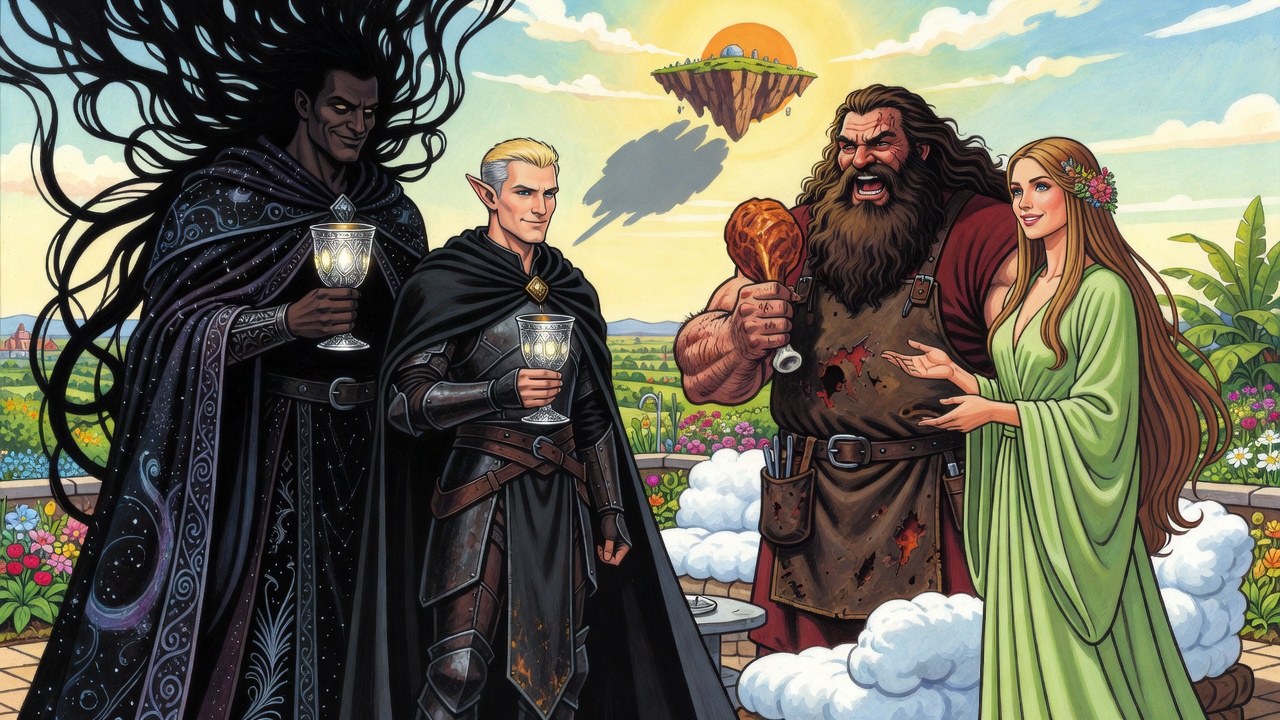
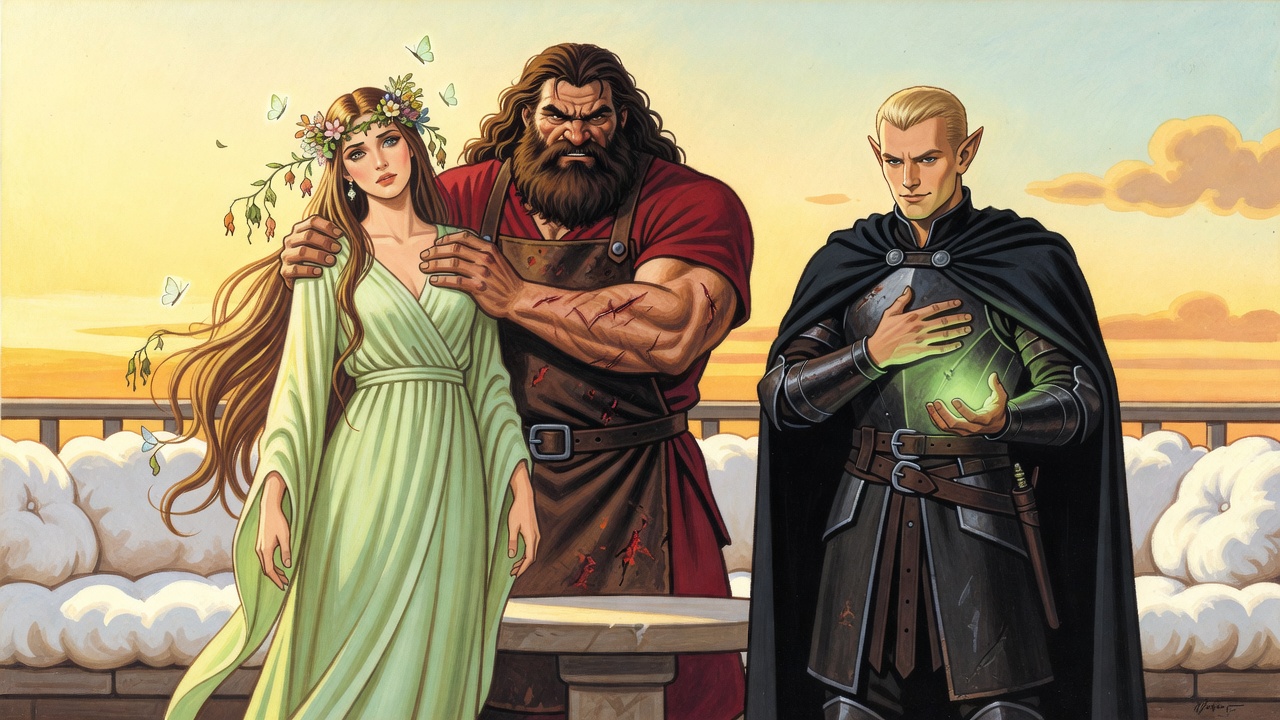
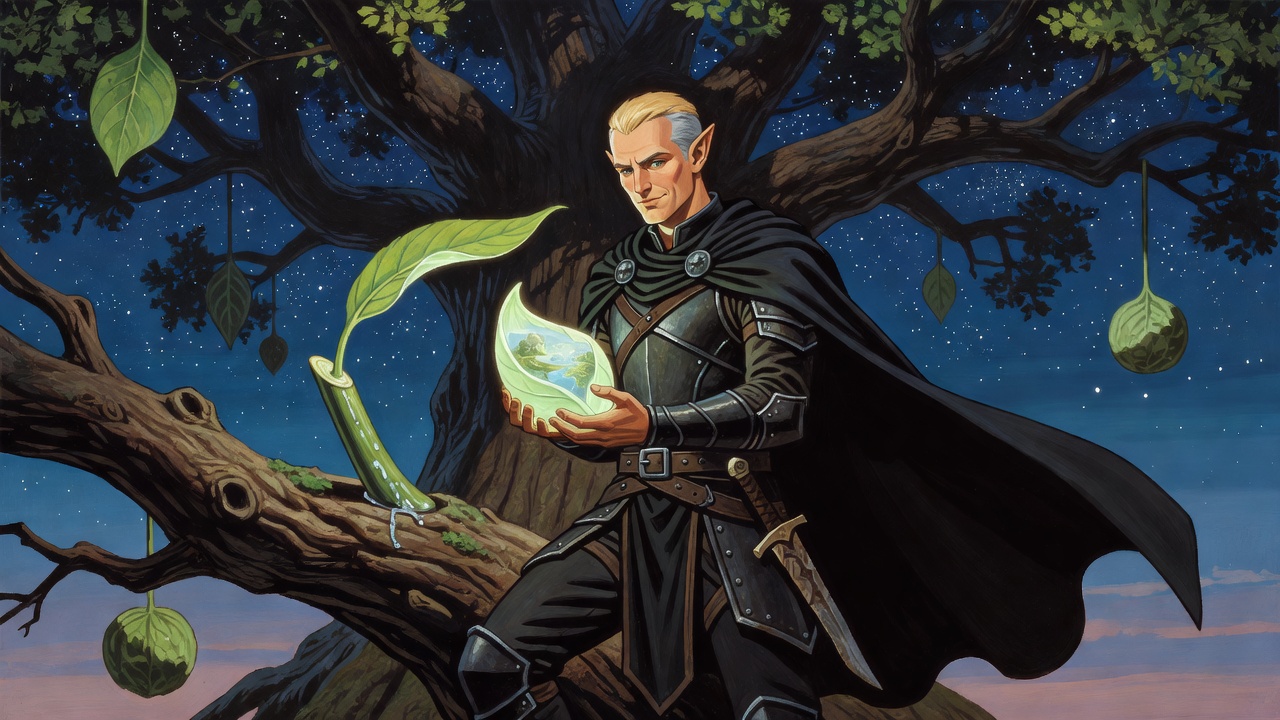
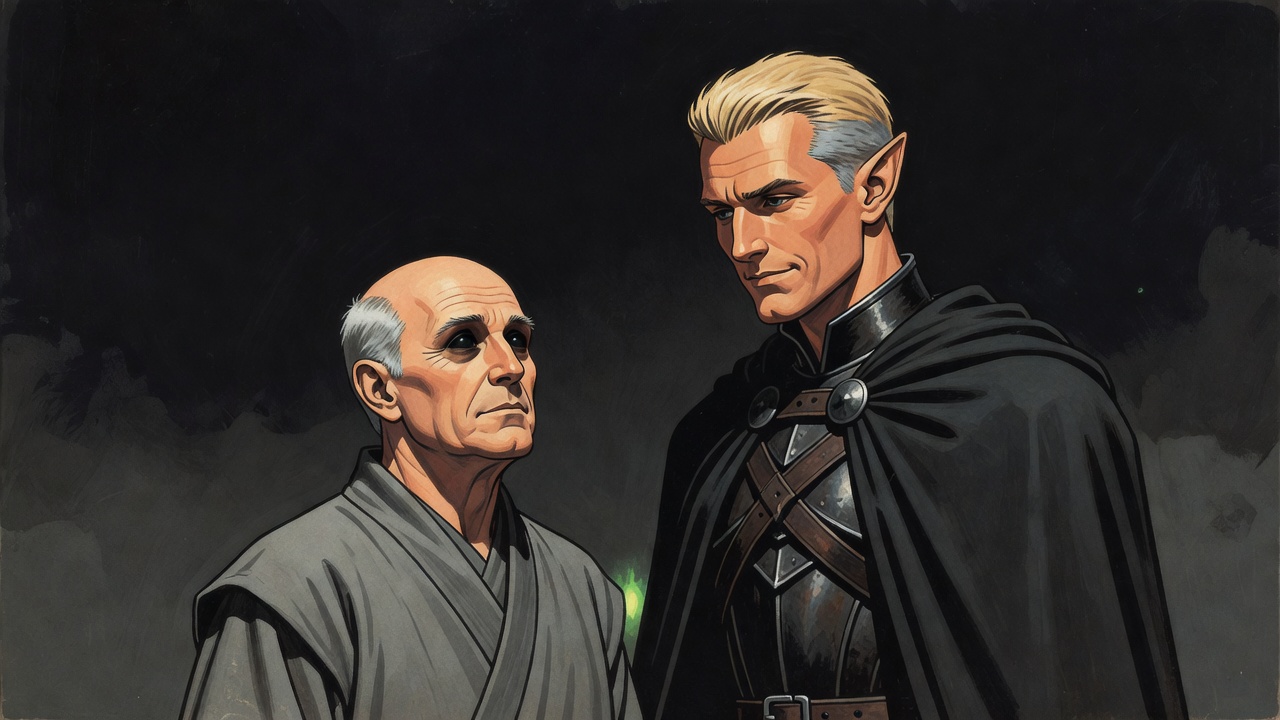
Laith has just teleported up from the minus tiers when he runs into his old patron. On the rooftop of No Mortals, a restaurant for serious gods only, the Fallen One lifts a filigree goblet to the young god. Aule, god of all gnomes, and his wife Yavanna share the table. Laith’s own pantheon waits as backup in a cheaper tavern across the street, and every five minutes he sends them an all-clear, three sevens.
Asked what specialization he has chosen, Laith owns up, reluctantly and then defiantly: Militant God of Justice. Happy people, the Fallen One remarks, don’t call for justice. Aule jokes that he and his wife are now gods of the dark pantheon, practically Laith’s antagonists. Why antagonists, Laith answers, when his pantheon is one of Balance, and not light at all? Then Yavanna breaks the news that his old pantheon has scattered: Asclepius has gone to Earth, where prayers for healing make him strong, and the dark gods have taken in some of the others.
He pays back a debt of a million with a conjured purse of a thousand mithril coins. The Fallen One says these are the very coins he will send Laith, which leaves Laith wondering whether he has just repaid himself. Then he confesses that he has been nudging Laith since Laith was a first-level elf. It was he who put a mosquito by the hermit Grym’s cave, so that Laith would not chase a hare and would meet Cryl instead. Only a few times, he claims, at the forks. Laith asks about the deaths of Taali, of Olga and of millions of other Earthlings, and his trust drops a few degrees. Then the Fallen One tells him that Olga is alive, frozen in stasis, and could be saved with effort. Laith resolves to repay her with a whole life.
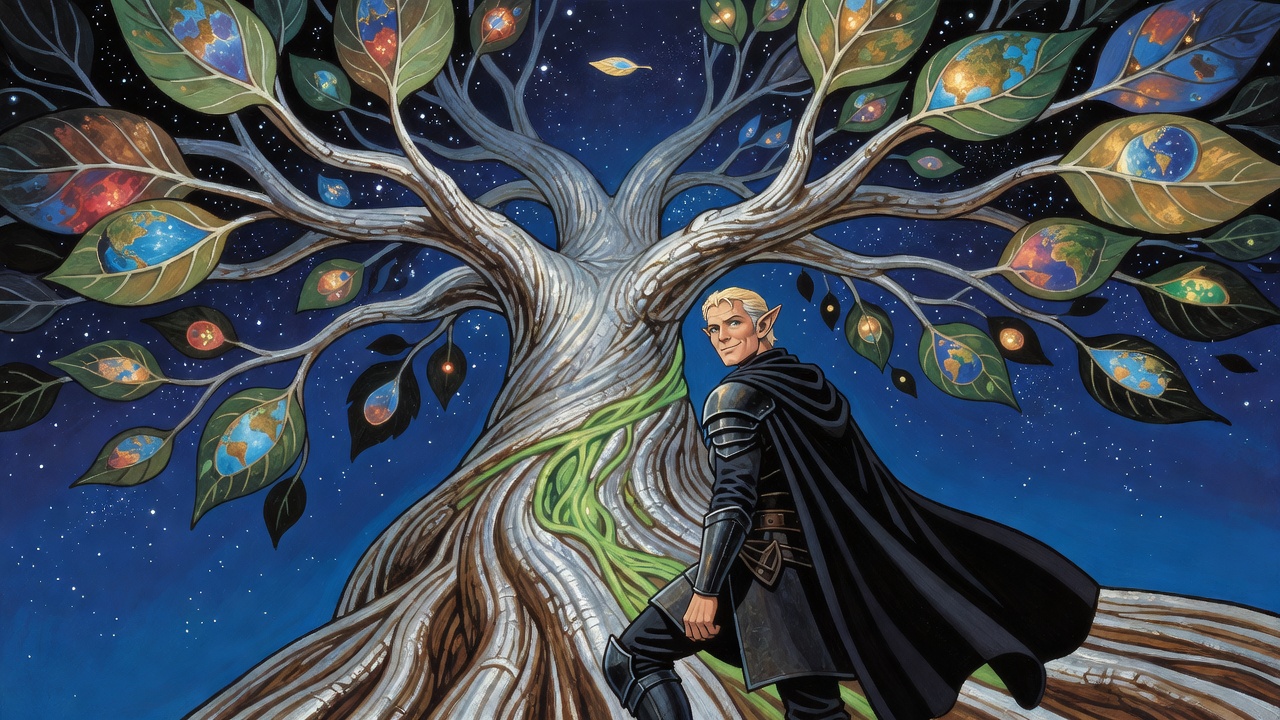
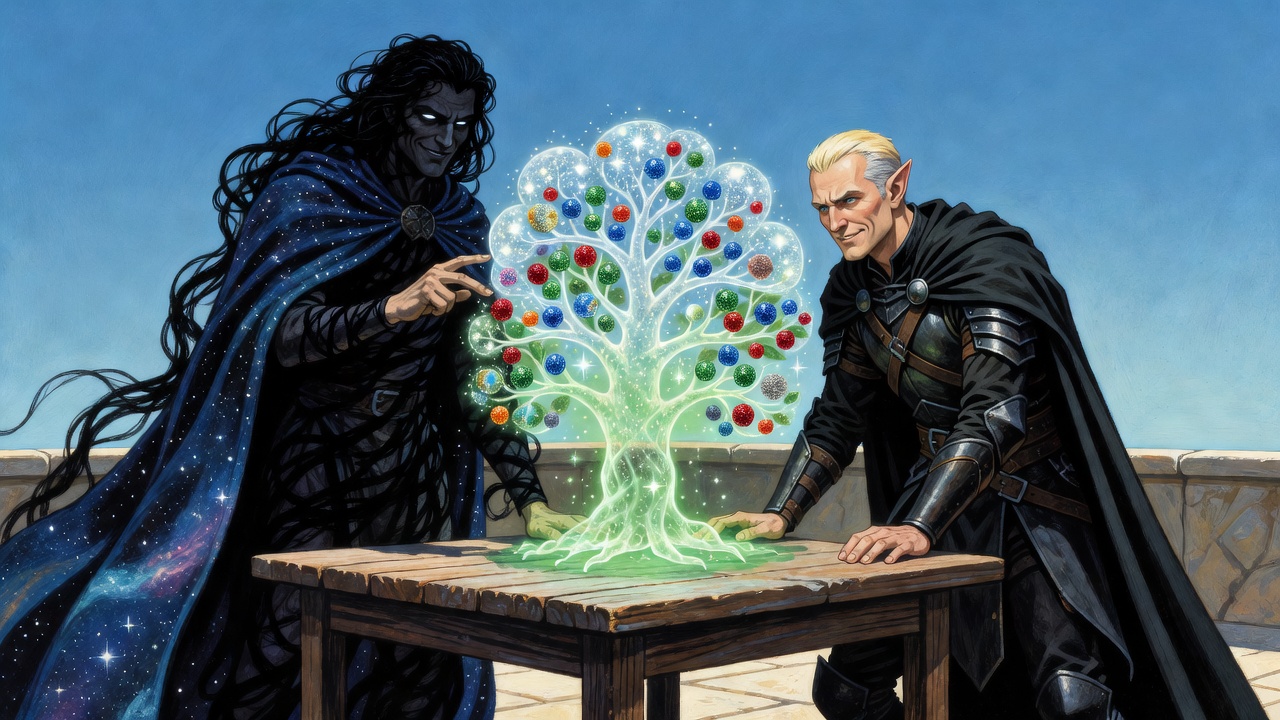
The Fallen One opens Divine Sight, which zooms from the Pisces–Cetus supercluster down to Earth, then back out into the World Tree. Earth’s universe hangs as a leaf on tier 56, crusted with scabs of local and virtual worlds. One of the scabs is AlterWorld, and the colours of its magic are visibly fading because Earth’s universe is draining its mana. AlterWorld is doomed.
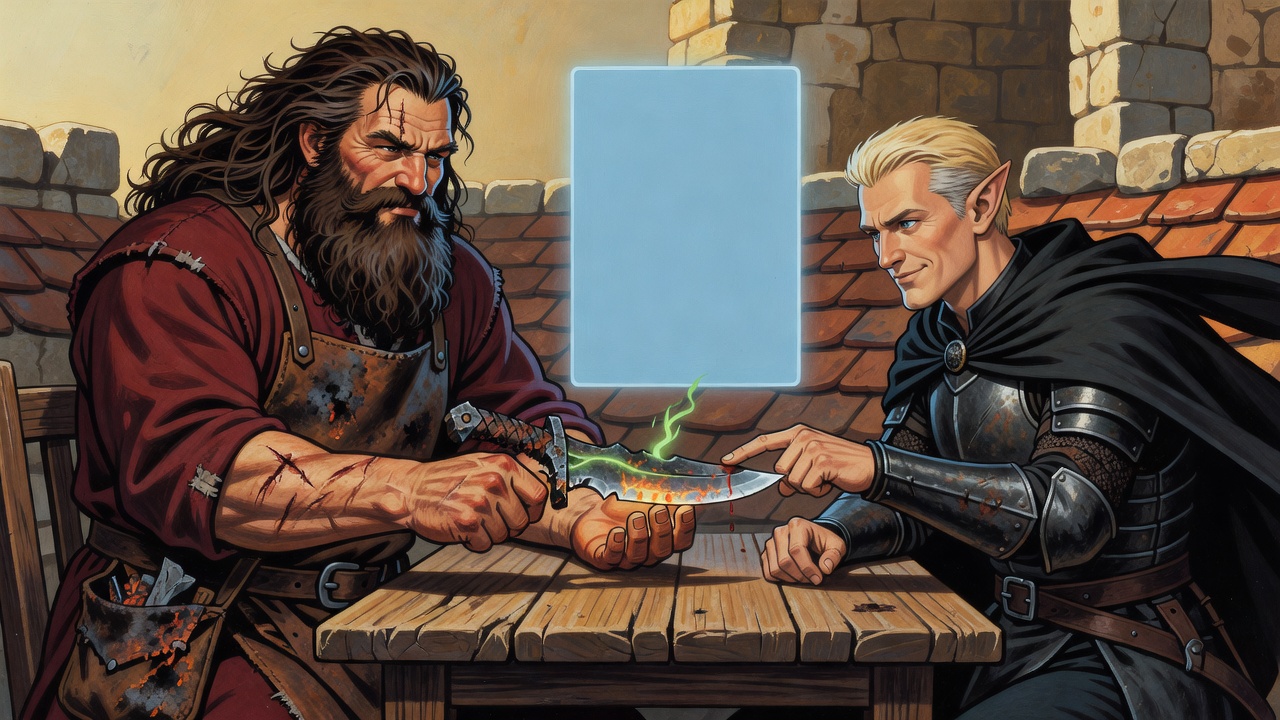
From a belt pouch scorched by sparks from the divine forge, Aule digs out the Reaper of Worlds. It is a crude curved dagger, horribly badly sharpened, 110 years in the making, and it can cut a leaf from the Tree, even a virtual bud. Laith is to cut AlterWorld off and graft it about ten tiers higher, onto a branch of magic worlds. Whoever moves a world becomes its supreme god, so the gods have settled on a compromise: the weakest god, aligned with no side, and a god of justice. Every god of AlterWorld has already given blood to the blade, and only Laith’s is missing. He nicks a finger on a burr, the blade drinks, and the Reaper turns active before the planned ritual.
Yavanna kisses him and lends him the skill Divine Herbalist, at level 1000 of 1000, for one year. The flowers in her hair wilt, her light-green robe fades, and she sways. She has given him part of her very essence, Aule rages, and Laith’s divine lie detector calls that a lie; Aule is a poor actor. Graft the world fast, Aule storms on, or die fast, so that her power comes back.
The rules of the road are hard. With a world in his inventory he cannot use portals; he has to walk. A cut world folds into a cocoon and its time stops, but it dies if it stays folded for more than a year, and if Laith dies while carrying it, it dies with him. When the Fallen One says Laith has no right to die, the lie detector reads it as a lie. When he says he believes in him, it reads true. Laith finds that strange, very strange.
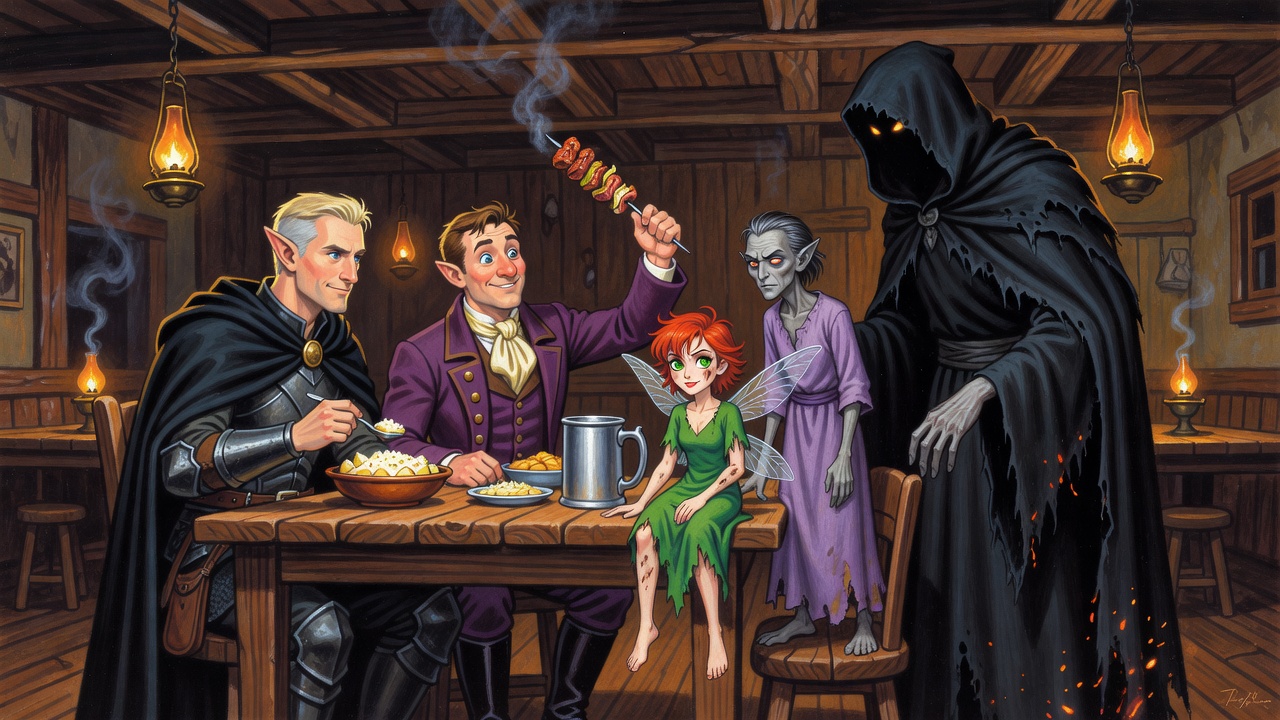
In another tavern Laith sits down with his own gods, for the Fallen One was wrong: his pantheon is not empty. The Pantheon of Balance is a level-1 pantheon with five of its ten places filled:
- Laith, deity of militant justice, level 62.
- Avos, deity of fickle luck, in the middle of changing his specialization, level 57.
- Sir, deity of the Lilac Valley, whose status line is a garble of symbols, level 36.
- Liya, goddess of the Red Meadows, the flower fairy from Book 8, level 39.
- Elkil, god of evil and nightmares, also changing his specialization, level 109. He is the polite, Nazgûl-like guard from Book 8, and he joined because he cannot go back down to the minus tiers, where time runs backwards.
Laith proposes they walk up to about tier 70.
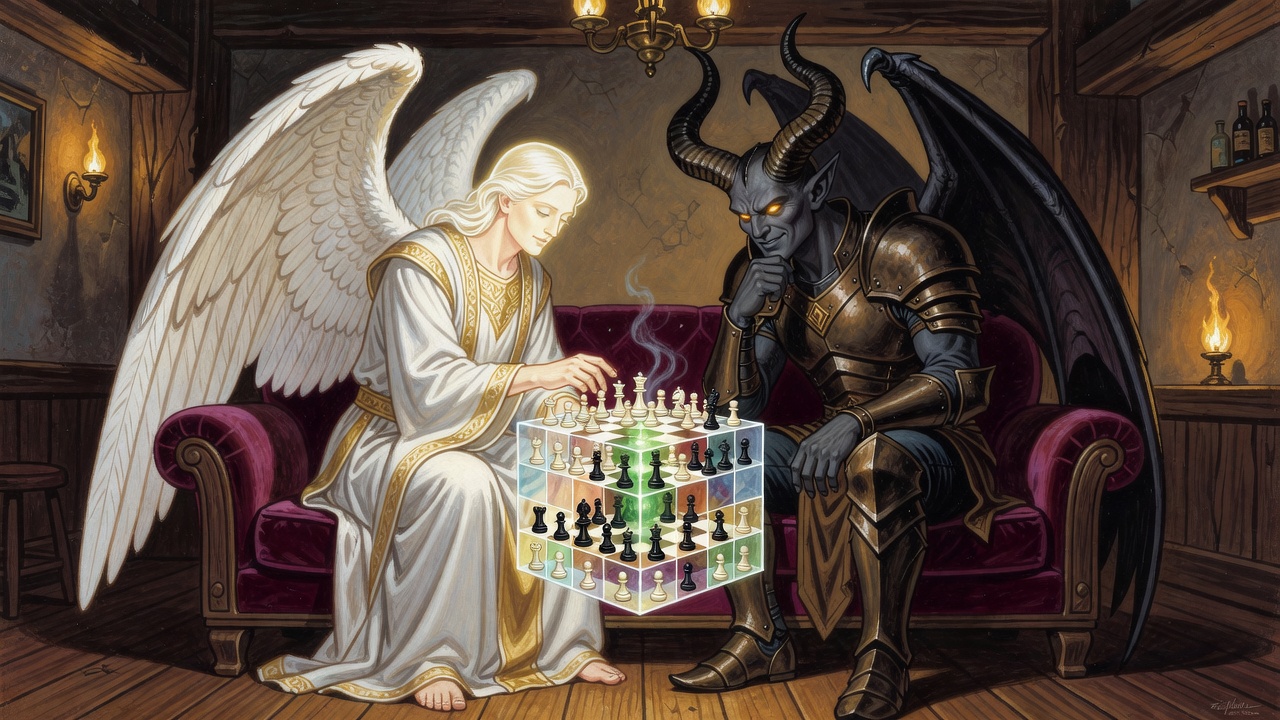
Laith eats Olivier salad from a precious 700-kilogram hoard; the others eat shashlik made of chaos-meat, the rat meat of the minus tiers. On the next sofa sit the two Emblems of the Creator, Light and Darkness, the Guardians of Level Zero, playing four-dimensional chess.
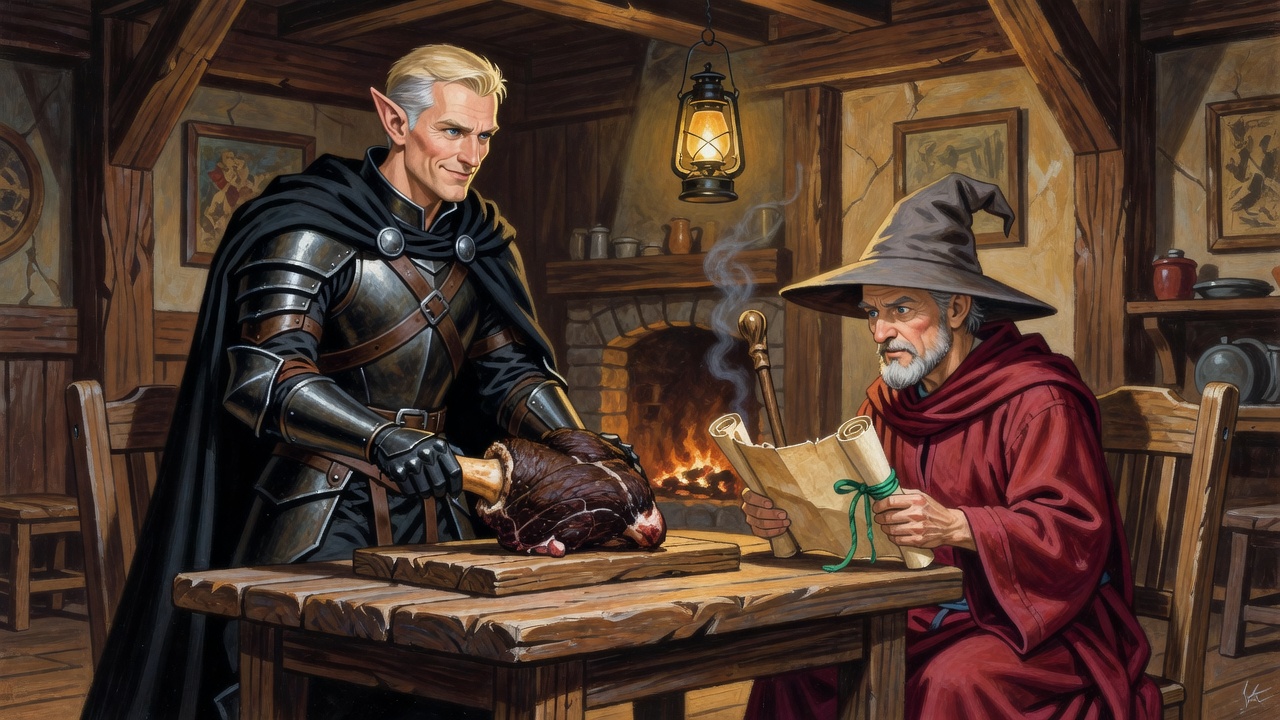
A mild old god in a Gandalf-style hat drifts over. He is Delmor, god of carnal pleasures, level 409, who picked up a craving for chaos-meat in nine thousand years on tier minus eighty. He offers coin, a six-bladed sword and an empty world on tier 42, but Laith wants a map of the upper tiers. After some hard haggling, a map of the whole Tree, up to the Creator’s penthouse on tier +81, costs seven tons. In an italic aside, two Shadows of the Creator watch him. He still hasn’t understood, says one. Shall they hint? No. He must get there himself, all by himself.
Years Pass in AlterWorld
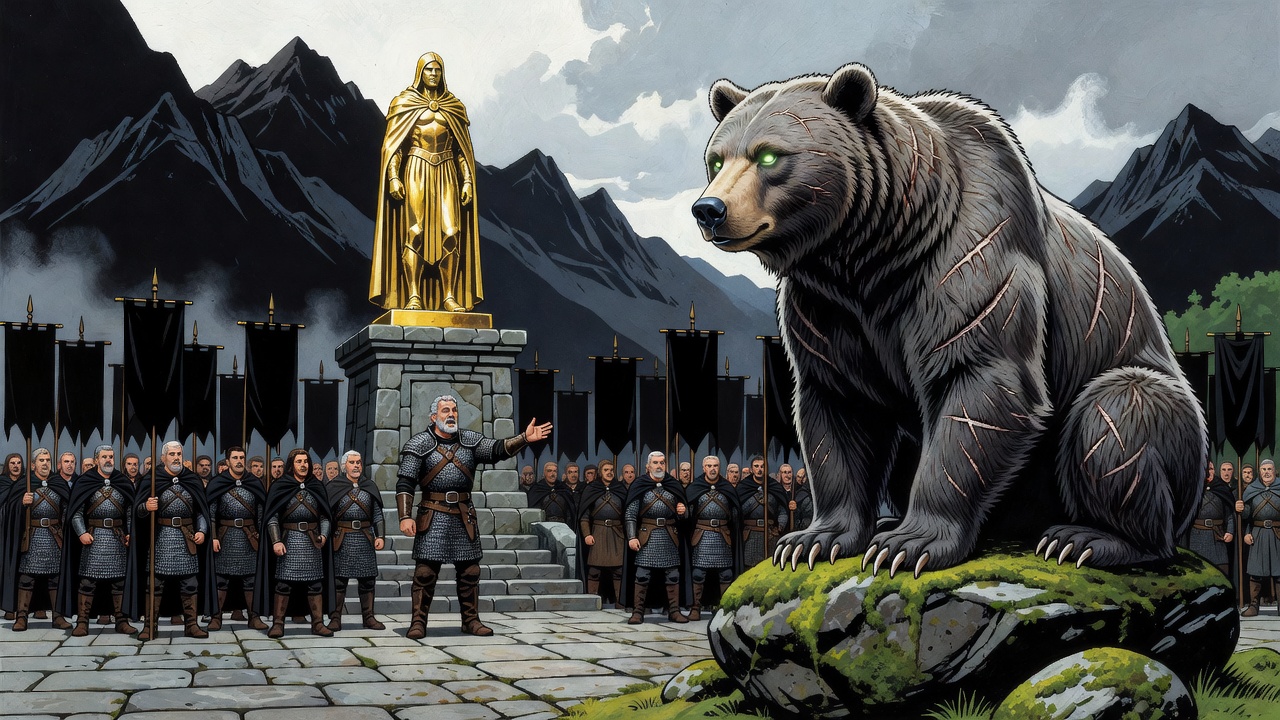
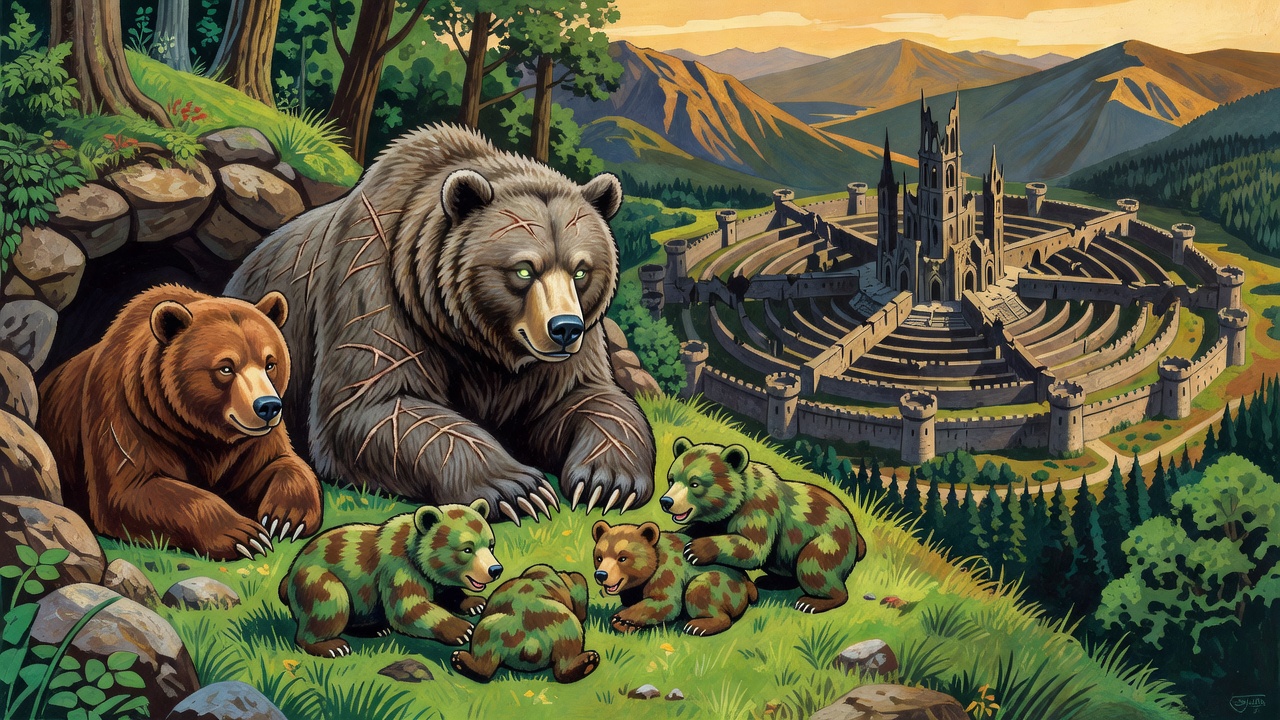
A side chapter goes back to AlterWorld. The clan Children of the Night raise a memorial, a full-length statue in gold. The original design called for mithril, and the clan balked. They stand in ranks, with banners and speeches. The battered bear Humungus watches from a low rock. A she-bear finds him there, the one that brought Eric, and the two go home to the First Temple together: a well-fed, caring she-bear and a deadly bear covered in a thick net of scars, known as the Nightmare of the Kashir forests. Years pass. Their camouflage-coloured cubs grow up, and grandchildren play by the den. But one day…
In the Nursery, meanwhile, Laith is learning manners. The Higher gods are egoists by nature, and his Mercenaries’ Guild handbook is thirty thousand years out of date. The new pantheon glows with borrowed power. Laith waits impatiently for the bear, and a capture team turns up instead.
Blood in the Nursery
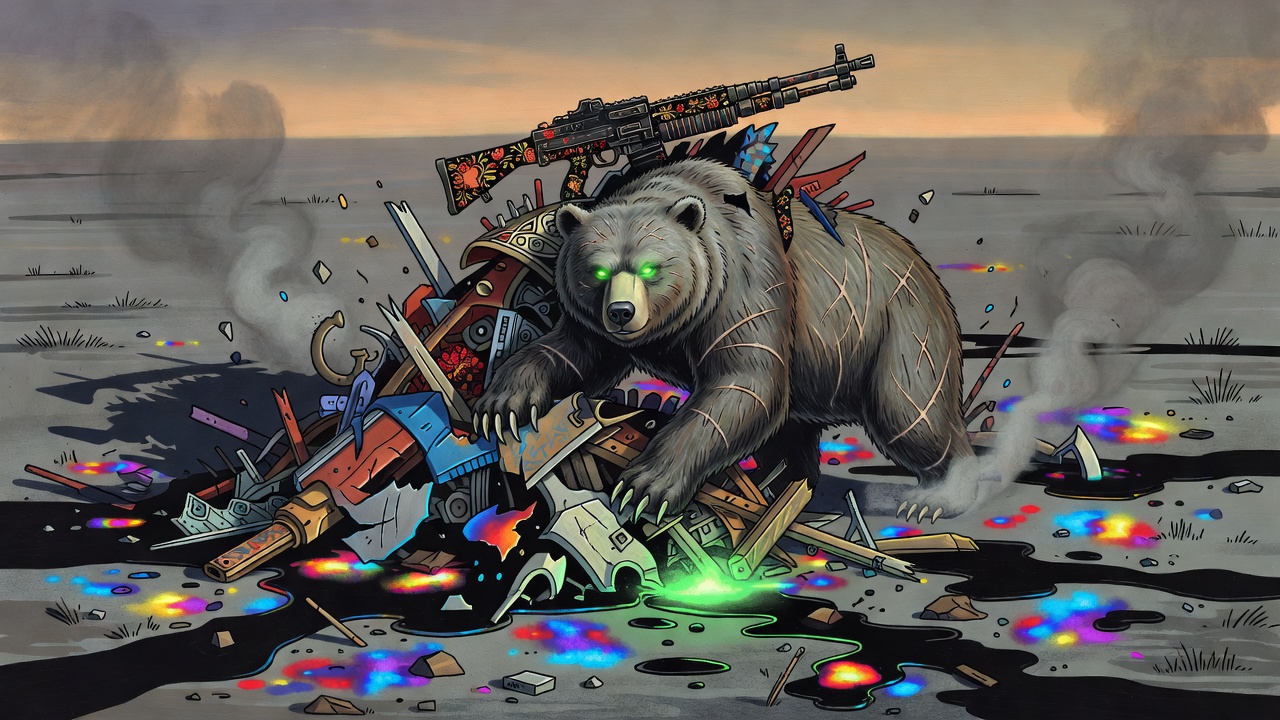
Laith refuses every shortcut. The shortest road and haste, he says, lead to a nameless grave. A third of the way in, the Nursery turns violent. Sir, the Lilac one, fights a duel that terrifies everyone who sees it. Afterwards he trails behind the party twirling a wood-chip, an odd sort of quartermaster who cares nothing for wealth. Someone mans a machine gun under joke buffs: a battle skin in Khokhloma, the red-and-gold Russian folk painting, that makes a machine gun ten times stronger in the Kostroma province, and a buff from Grandpa, for victory. Humungus is with them now. Growling with impatience, he rakes through a mountain of bodies awash in blood of many colours, machine oil and glowing blots of energy. Afterwards Laith deals first with a weeping gremlin, cradling a scrap of machine-gun belt in its burned hands.
Something is taken from the party: a prized ingredient and, Laith fumes, the absolute weapon. The Russian publisher’s pitch says the hero loses his power, so that from now on one mistake means death. The highlights do not say what was lost. What follows is savage. The party makes several lightning raids to seize property, and so much blood is shed that morality and pity fall into depression. When someone warns him that an adamant brick can fall even on a god, he knocks the warning back down the speaker’s throat.
As the party leaves, the pair of demons from the Guard pocket their multidimensional chess cube and fall in as bodyguards; the one with a broken horn throws a service Eye into the sky, where it turns like a radar dish. Ahead stands a vast hub where six clusters join like honeycomb. A system quest arrives: kill all digital gods. Bonus: start with yourself. Reward: according to deeds.
The Cut World
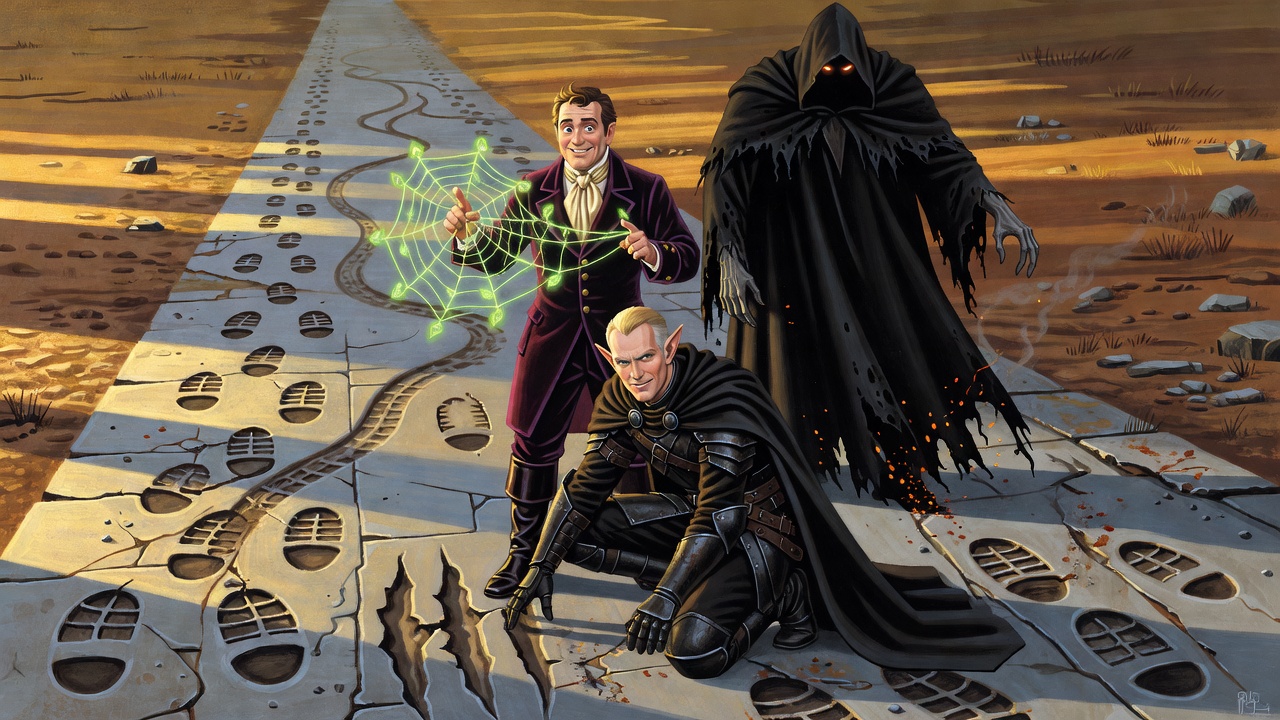
Near the middle of the book, Laith speaks the line the whole commission has been heading for: he takes on himself the fate of the cut world. That world is almost certainly AlterWorld, now folded into its cocoon, with its time stopped and the year’s clock running. One reader praises the idea of the world embryo. If a creature the size of Mars aggroes on him, Laith jokes, where is he going to bury it?
Someone called the Bringer of Happiness turns up, the title Tavor gave himself in Book 8. In one world, people pressed a button and pressed it again, dying of thirst and hunger, and dying happy. Strike runes inlaid with adamant gleam on some beast’s front claws, and the ground they cross keeps billions of years of tracks: hooves and claws, wings and tentacles, mechanical manipulators and cords of force. Avos turns strategist, and a magic scheme of his earns a raised eyebrow of approval from Elkil.
The Glass Desert and the Bridge
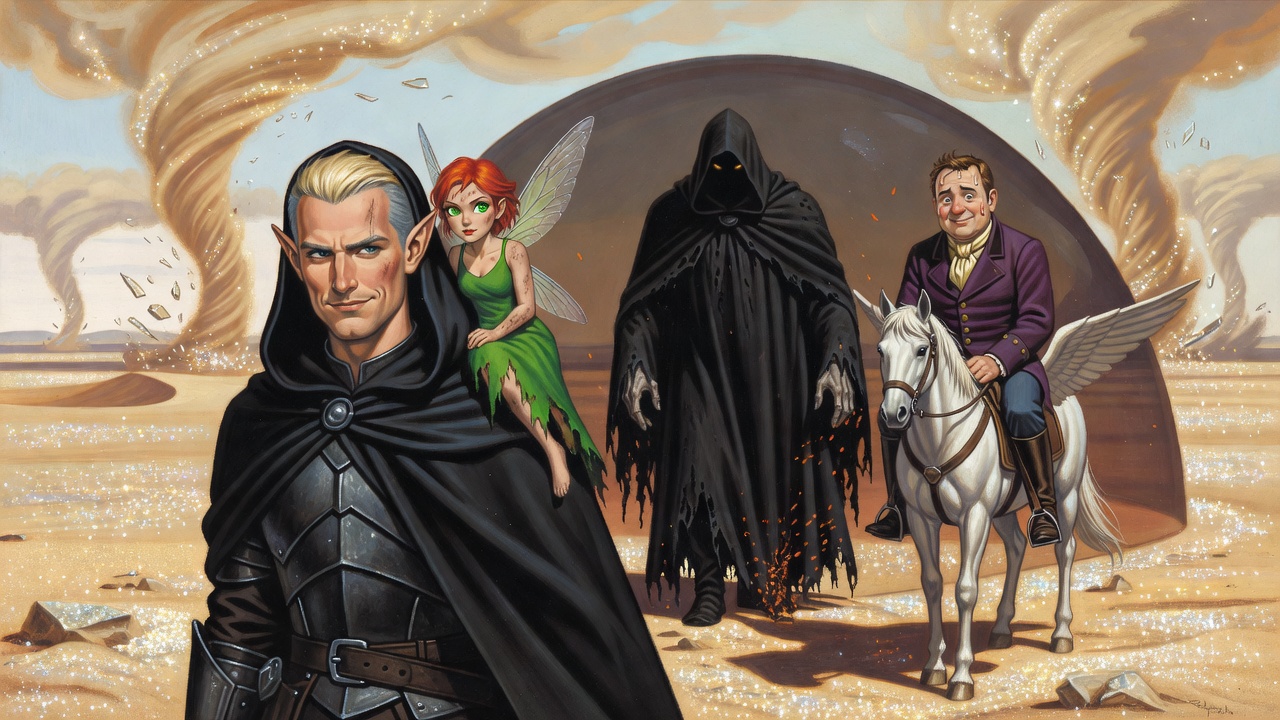
The party marches some 120 kilometres west to a transition zone. They cross a desert of glass sand that drinks magic, under a sun that drains their strength, while tornado columns herd them off course. Laith seals them under a darkened, air-conditioned dome. The fairy declares the weather unfit for flying and rides in his hood. Elkil, in his boundless cloak, looks made for the place, while dapper Avos suffers on a thin-legged winged horse. Elkil dissolves a desert spirit that runs off to report them. Laith pockets a severed manipulator from a techno-god, and the sand throws up a gold chain set with an uncut yellow diamond. He offers his friends shelter in his Chambers, his personal pocket-world, and they refuse.
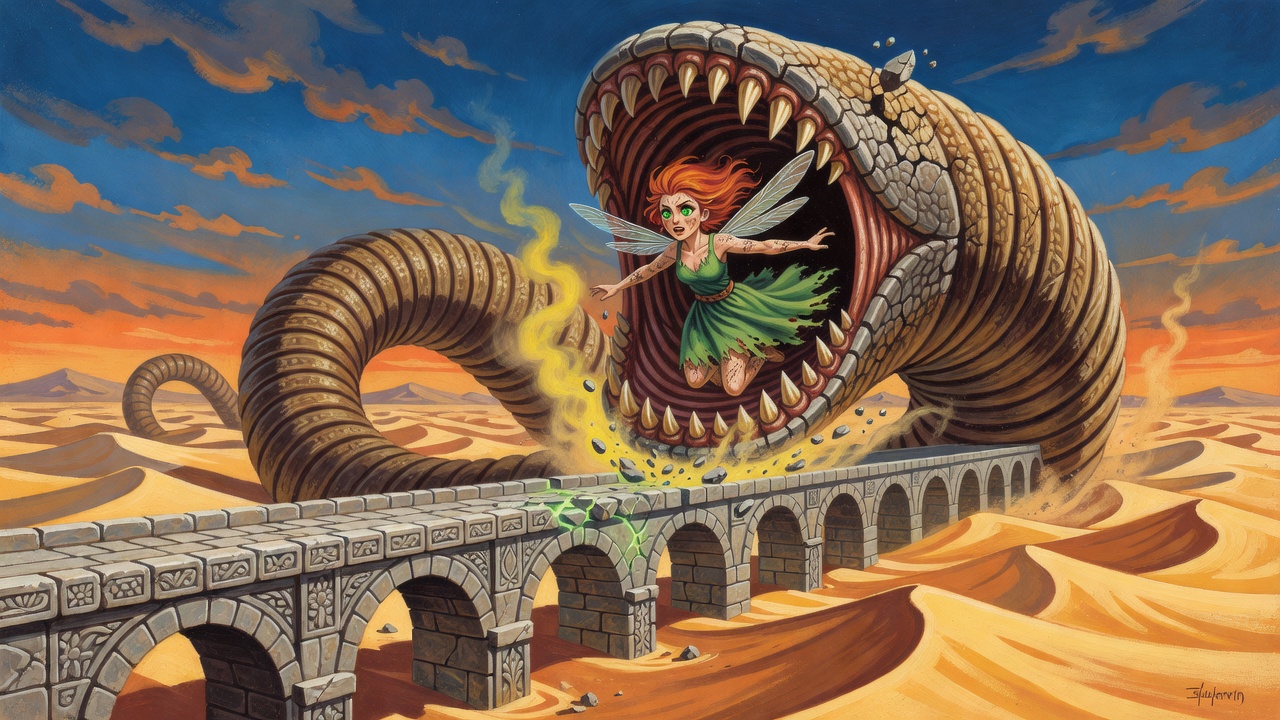
Next comes a granite bridge whose drawbridge arches rise like camel humps, built tall enough for sand-battleships to pass. A worm the size of Moscow’s Ostankino TV tower is battering the stone. The bridge heals itself, and it heals anyone who trusts it. The fairy goes for the worm’s weak spots, spitting, until its fumes poison her. She is put into a healing sleep in the Chambers, where a hard-swearing Durin is taking in a third body. The party also keeps a nearly whole statue of the goddess of life; they stopped cutting healing plates from its pedestal when its face twisted in pain. Laith tags the fleeing worm, hoping to tame its eggs with his Brood Hen skill. Good can often do more than naked force, he observes, and a kind word and a pistol more still. One reader remembers a robot sacrificing itself on a bridge.
Good Must Have Fists
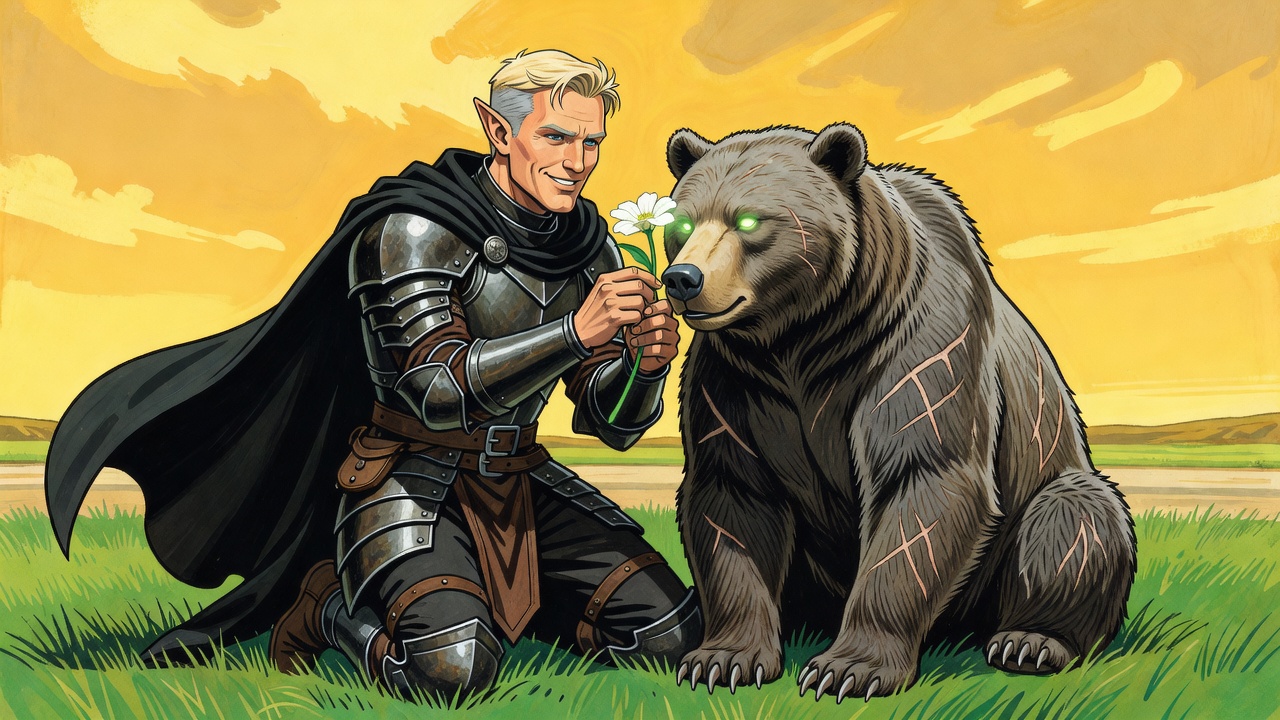
A quest arrives whose name amounts to For All Good Against All Bad. Its probable meaning: restore justice. Its reward: a satisfied inner sense of justice. Its penalty: disembodiment. Rule number one, Laith announces with a finger raised: good must have fists. Then he recites a Soviet poem from his childhood. A line from the Internationale echoes, about building their own new world, and Laith sighs over his little pantheon: hug it and weep. He tucks a flower behind the bear’s ear, tells the shaggy one to sniff it, and reflects that whoever won’t pray to his own gods will pray to someone else’s.
The party marches on, inflicting good and causing justice. Laith, a god who is Russian by passport, declares that he will favour Russia and that sad times await the Europes. Many readers object to these patriotic asides. In a side scene whose place in the book is uncertain, a fairy runs a donation box for the restoration of the Citadel. A shuffling deity of male pleasures pays and flees; she fishes his silver coin back out with a thin dagger, tucks it into her cheek and declares that God gave and God took away.
The Creator’s Killer, and a Road That Loops
Morning in the Chambers: Laith waves off his butler and gulps coffee while a magovisor picks up a techno-civilization’s broadcast, two crystals slowly rubbing together. Talk of war comes round again, and Laith is tired.
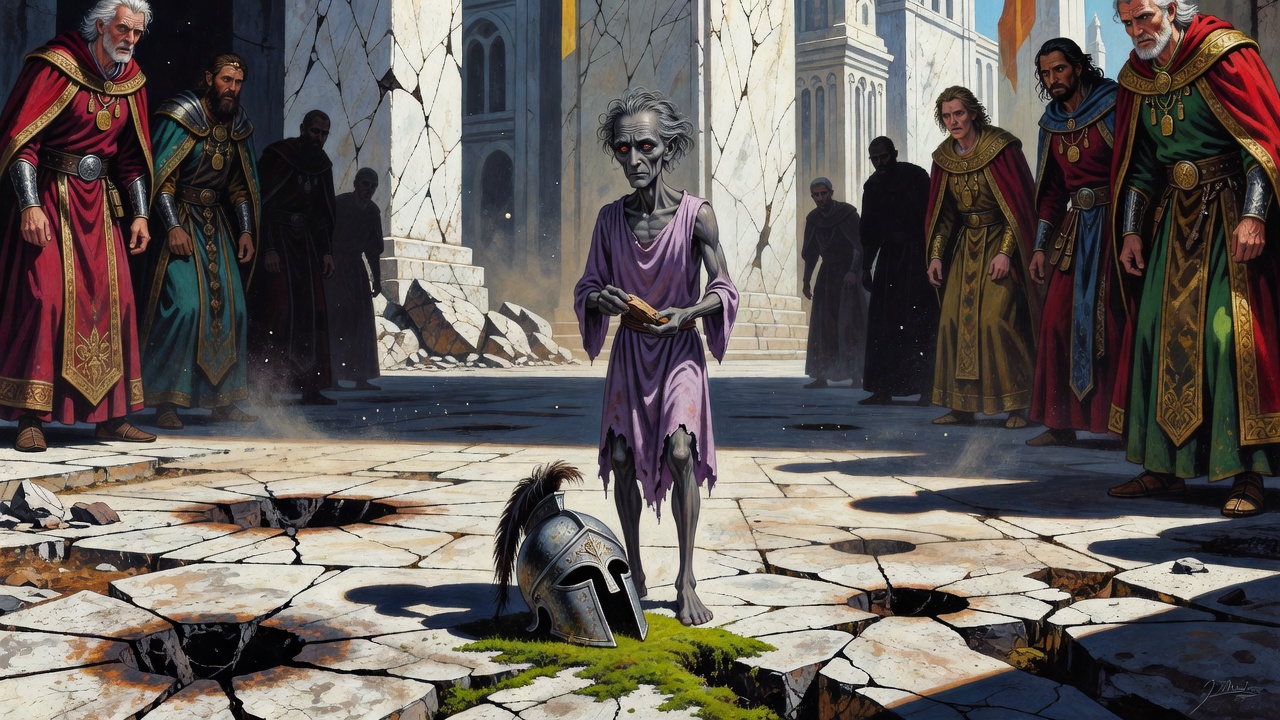
About nine-tenths of the way through come pages on the fatigue that piles up over ten thousand years of life: wanting to cry and having forgotten how, wanting to die and being stopped by mental blocks. Whose fatigue it is, the highlights don’t show. A little god raises a bottomless gaze to Laith and tells him he is not the Creator: he is the Creator’s killer. A fragment from the same pages speaks of gods given specializations, adamant collars, and minds processed by the Creator. One reader says the book speeds up once Sir’s identity is revealed, but the highlights never name the little god. Laith recalls the First’s rule: repay good with good and punish evil tenfold. The only problem, he says, is where to find that many tortures.
Then time comes loose. A passage readers marked, its place in the book unknown, runs one young woman’s life through version after version. She is arrested while preparing, taken while leaving a firing position, killed in custody. A dozen times she gives up, and her mind drags her into the very hell of the worlds’ Breakdown. Readers also describe:
- games with time in which the hero tries to save someone and only makes things worse;
- Laith living through his memories;
- the return of an old enemy;
- old friends who turn out to be worse than he thought;
- the Fallen One deceiving him over the world (one reader).
The ending, as readers report it, comes in jumps:
- stone followers freeze, and a god dies;
- the Chambers hang in nowhere;
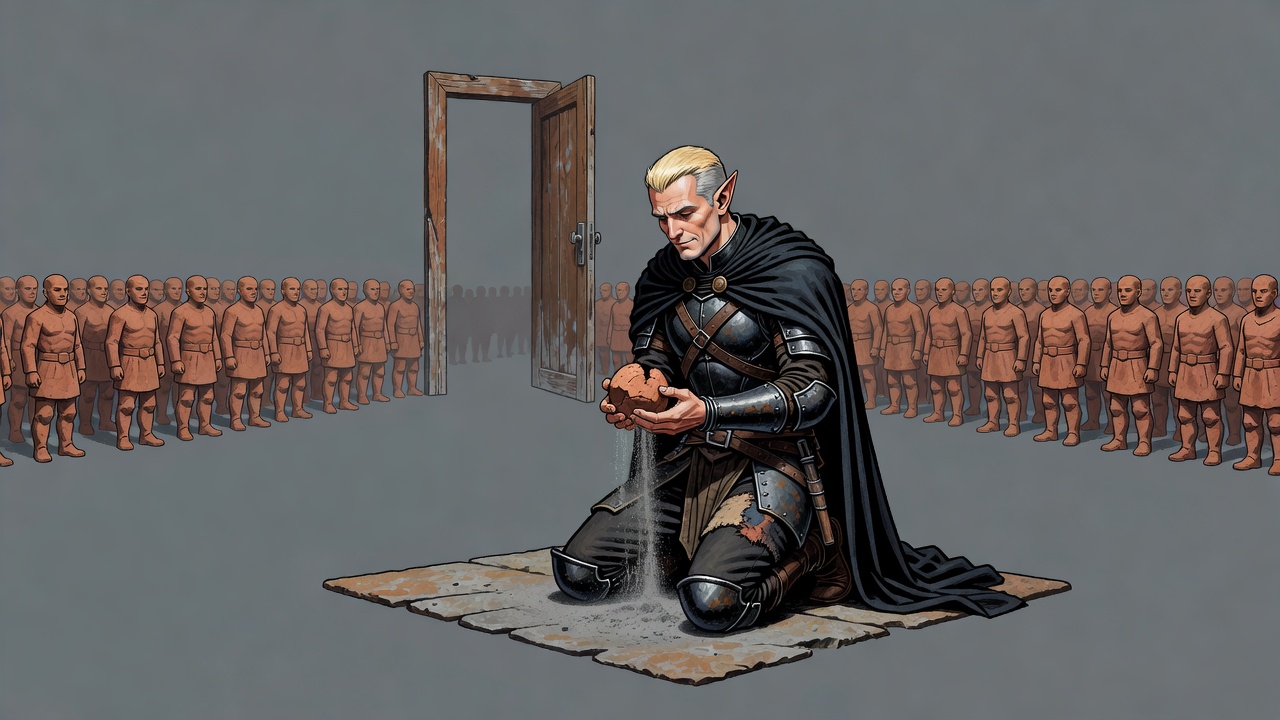
- his friends are left in a divine stasis, like terracotta warriors;
- AlterWorld is left without magic. Its sprout is lost who knows where, and a fake of it crumbles to dust in a pocket of space;
- one reader describes a return from level 81 to 80, as if into the past, and asks how Laith and Elkil can then meet for the first time.
Some readers take it that Laith dies. Nothing we could read settles it, and this page leaves it open. Readers agree that he never gets back to AlterWorld and is not reunited with his friends. The road home breaks off at the most interesting place, and Book 10 has not been finished.
The game in this book
- A god’s character sheet. Laith is a level-62 god whose specialization is Militant God of Justice. A divine lie detector tells him true or lie, and with a click of his fingers he can drop a dome of silence over a table. One reader reports that later he is level 88 against enemies of level 400.
- The pantheon as a party. The Pantheon of Balance is a level-1 pantheon with five of its ten places filled. Its bonuses: members can teleport to each other, sense each other’s status, and gain 1% of power per god. Two members, Avos and Elkil, are partway through changing their specializations. Avos comes out as a strategist.
- The Reaper of Worlds. Durability 1/1. Saturation 13 of 14, holding the blood of every AlterWorld god but Laith. It is called useless and almighty, and it carries a warning about the Creator’s wrath. In effect it is an admin key with root access to one created universe. Whoever moves a world becomes its supreme god. AlterWorld’s address on the Tree is 56.1.2.89.1921.
- Hardcore mode. With a world in your inventory you cannot use portals. A cut world folds into a cocoon and its time stops, but it dies after a year folded. If its carrier dies, it dies.
- Borrowed and odd skills. Yavanna lends Laith Divine Herbalist at level 1000/1000 for one year. He also has his own herbalism, and Brood Hen, which he hopes will let him tame a worm’s eggs.
- Money. Owls are the divine coins, and faith points are spent like money. Chaos-meat, rat from the minus tiers, is the pantheon’s export: Delmor offers 200 owls a kilo, and seven tons buys a map of the whole Tree.
- Quests as satire. One system quest orders him to kill all digital gods, with a bonus for starting with himself and a reward according to deeds. Another, roughly For All Good Against All Bad, offers a satisfied inner sense of justice as its reward and threatens disembodiment as its penalty.
- The Chambers. Laith’s personal pocket-world takes in the wounded, with Durin tending them while a proper hospital room is grown in subspace. Highlights also mention a butler, a common hall with a magovisor, and a bunker with an artifact bed. His friends turn down his offer to shelter there.
Continuity notes
- Laith starts as a level-62 god on Level Zero who has just climbed out of the minus tiers. By the end, readers say, he has looped back in time and may have died. The page leaves that open. He never reaches AlterWorld.
- AlterWorld (Russian Drumir) is doomed at the start, almost certainly cut from the Tree near the midpoint, and by the end, readers say, it is without magic: its sprout is lost and a fake of it has crumbled to dust.
- The Fallen One is repaid in a time loop and confesses that he has steered Laith since Book 1, from the mosquito at Grym’s cave onward. One reader says he deceives Laith over the world.
- Olga, murdered on Earth in Book 3, is alive in cryo-stasis. She is not rescued in this book.
- Yavanna lends Laith her herbalist’s power for a year and looks weakened by it, but Laith’s lie detector calls Aule’s claim that she gave up part of her essence a lie.
- Elkil, the Nazgûl-like guard of Book 8, is now in Laith’s pantheon. One reader places him with Laith at the time-loop.
- Humungus mourns at the memorial and raises a family at the First Temple with the she-bear that brought Eric. By a third of the way into the book he is with Laith’s party. In the glass desert a little bear called Gummi, very likely Humungus under a pet name, is bundled into the Chambers as too small for the danger, with a warning about abusing resurrection; whether he is still giant-sized is unclear.
- Tavor, who called himself the Bringer of Happiness in Book 8, is still at large. The book curses his name, readers want him punished, and nothing is resolved.
- The old AlterWorld cast is almost entirely offstage, and the Hamster, Laith’s greed-spirit, is absent from this book.
Notes
- The series is unfinished. A Russian Book 10 is listed as unfinished, a web serial with a 2024 self-published audiobook and no English edition. Amazon calls The Road Home “Book 9 of 9”. No statement from the author about finishing or abandoning the series was found.
- How this page was built. Chapter 1 (about 7% of the book) comes from the Russian publisher’s free excerpt. Everything after it comes from 126 reader highlights placed by percentage on Yandex Books, about 560 reader reviews, and the Eksmo pitch. Only the English publisher’s blurb is quoted. The book’s own lines appear here as paraphrase.
- Names. No sample of the English text could be checked. Avos, Sir, Liya, Elkil, Delmor, Durin, Gummi, the Children of the Night, No Mortals and the Reaper of Worlds are our renderings of the Russian, not the translation’s forms. This site spells the smith-god and his wife Aule and Yavanna throughout; the English edition’s own spellings are not confirmed (the research recorded English reviewers writing Aüle and Yvanna). One English reviewer thinks Elkil appears as both “Elekys” and Nazgûl. Another asks when AlterWorld changed its name; in Russian it is Drumir.
- The fairy who rides in Laith’s hood is not named in any highlight we have. Liya, the pantheon’s flower fairy, is the obvious candidate.
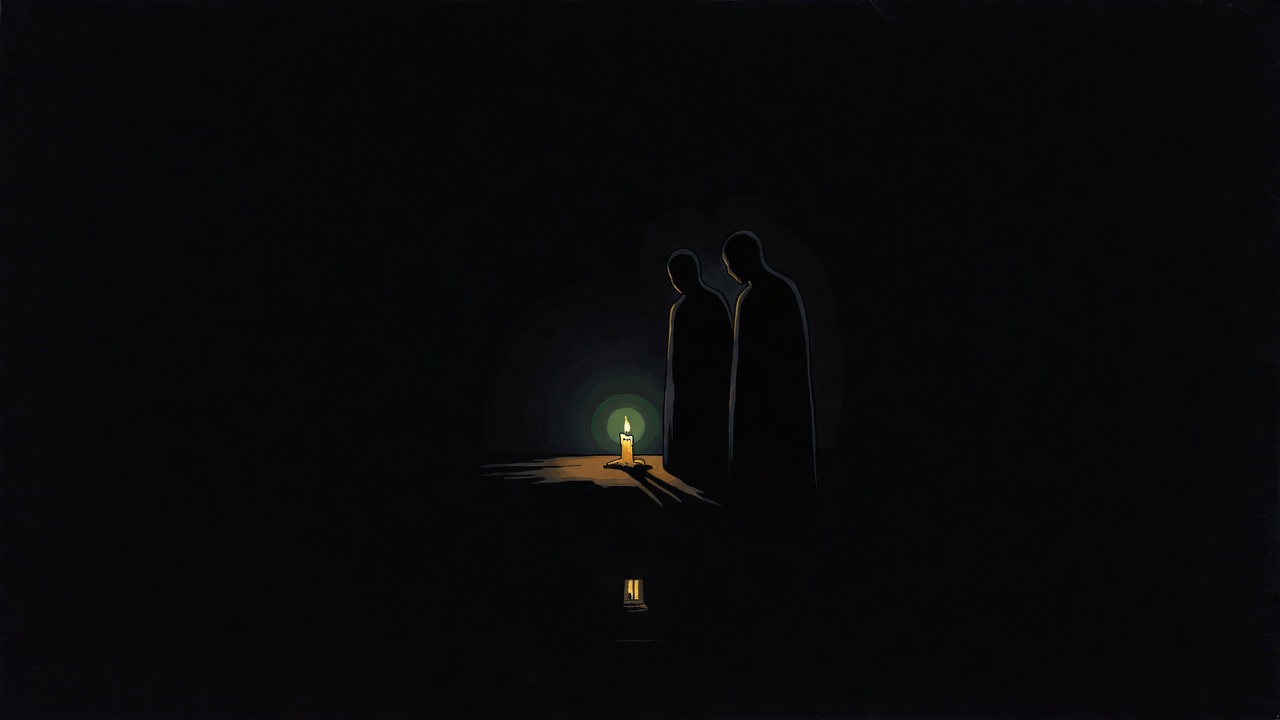
- The candle passage that Russian bookshops print as this book’s annotation (a candle-stub “of His flesh” in the Great Nothing) is Book 8’s prologue reused. Chapter 1 opens with the toast.
- Reception. Goodreads 3.47 (73 ratings), Amazon 3.6 (85), fantlab about 7.2. Readers split. Many feel that Books 8–9 read like another author. They complain about the cosmology, the missing old cast, the patriotic asides and the abrupt ending, while admirers praise the scale and the jokes. English readers also report name drift and a disjointed last quarter.
- Editions. Russian: Eksmo, Moscow, 2021, 352 pages, ISBN 978-5-04-120893-6, print run 3,000; audiobooks read by Gennady Korshunov (self-published; fantlab dates it 2020), Ivan Shevelyov (1C, March 2021) and Ilya Dementyev (2025). English: Kindle, 258 pages, ASIN B0DRCGXLBR, and a paperback. No English audiobook was found; a German one, Der Heimweg, read by Julian Mill, came out in 2025.