Play to Live · Book VIII · 2020 (English 2022)
A Newborn God
Forty days after the last battle his friends are still sifting a crater for him. He wakes in the Divine Nursery as the least of AlterWorld’s gods, and the first thing he does with his faith is give it away.
AlterWorld: A Newborn God is the eighth Play to Live novel and a fresh start. D. Rus came back to the series five years after The Ultimation, posting the book online in 2020 before Eksmo printed it that year (the Russian title means The Young God’s Path); the English Kindle edition followed on May 26, 2022, with no translator named. At the end of Book 7 Laith destroyed Asmodeus and vanished in the blast. Here he wakes up a god, last of the twenty-nine in AlterWorld’s pantheon.
Laith tells it himself, mostly in the present tense, with a log that never stops talking. Short third-person interludes, dated Year 22 by a calendar that counts from the Battle at the walls of the First Temple, cut back to the AlterWorld he left behind. Russian reviewers say the author has started the series over in another world, a god dropped back into the beginners’ zone: where Book 1’s hero farmed gnolls, this one farms rats.
A word on sources. The publisher’s free excerpts run from the opening to the start of Chapter 4 of 17, about a quarter of the book, and the first four movements below are told from them in detail. The last movement rests on reviews, passages readers have posted, and the first chapter of Book 9, and says so. The only English text of the book found anywhere is its prologue.
Forty Days Later
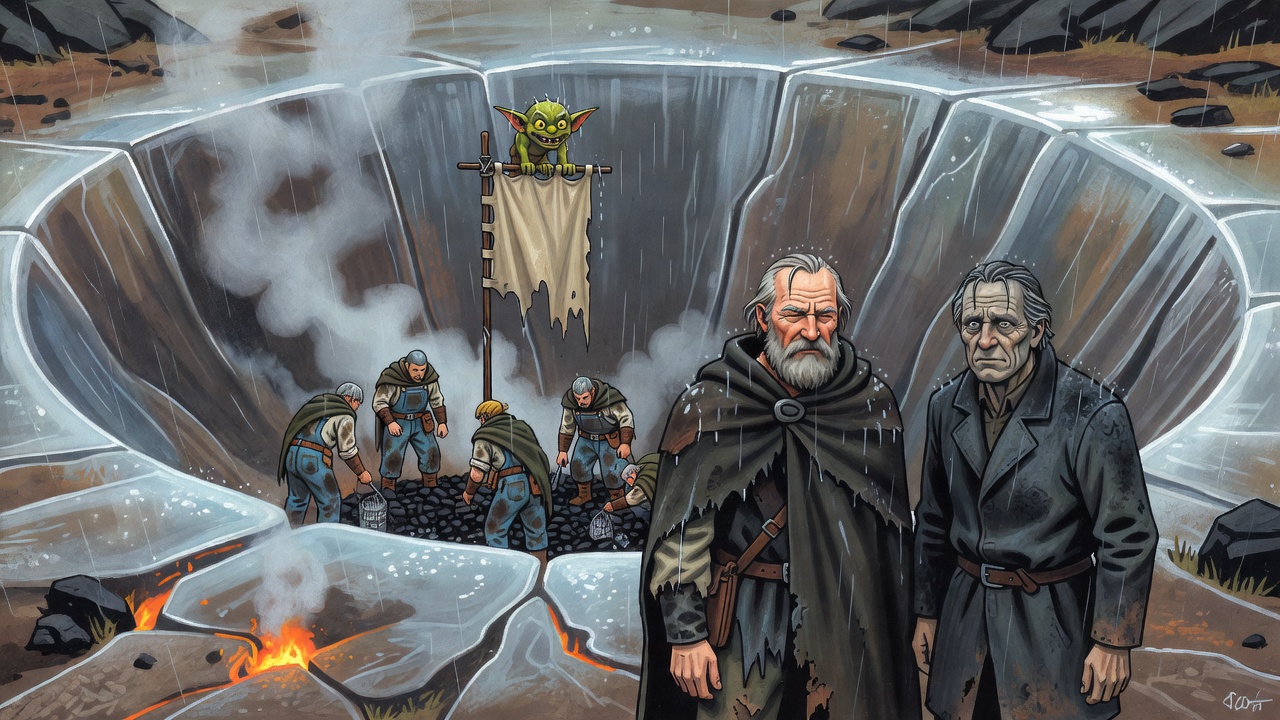
Forty days after the battle in which Laith destroyed Asmodeus, a cold drizzle that never stops hangs over the battlefield in Inferno. Hundreds of hunched figures, humans, orcs, dwarves, goblins and trolls, in dark cloaks, drow silk masks, army camouflage and technicians’ blue overalls, sift melted basalt for any trace of their missing clan leader.
Orcus, the clan’s head of counter-intelligence, joins Alexei Mladkor at the rim of the crater: a perfect funnel four kilometres across, blasted by one man, its walls fused ten metres deep into a transparent, indestructible, almost frictionless alloy of rock, mithril and divine blood.
Without its First Priest the alliance is coming apart: the hounds are getting cocky, the dragons will listen only to Lena, the Light factions are massing, and strangers, hidden virtual police among them, have been seen in the Frontier. Mladkor snaps that their leader tied far too much to himself. Orcus can only pass on what the Fallen One says: he is fine, just wait. Today is the last day of the forty-day afterlife granted to everyone who took part in the battle; more than 17,000 gravestones have been found.
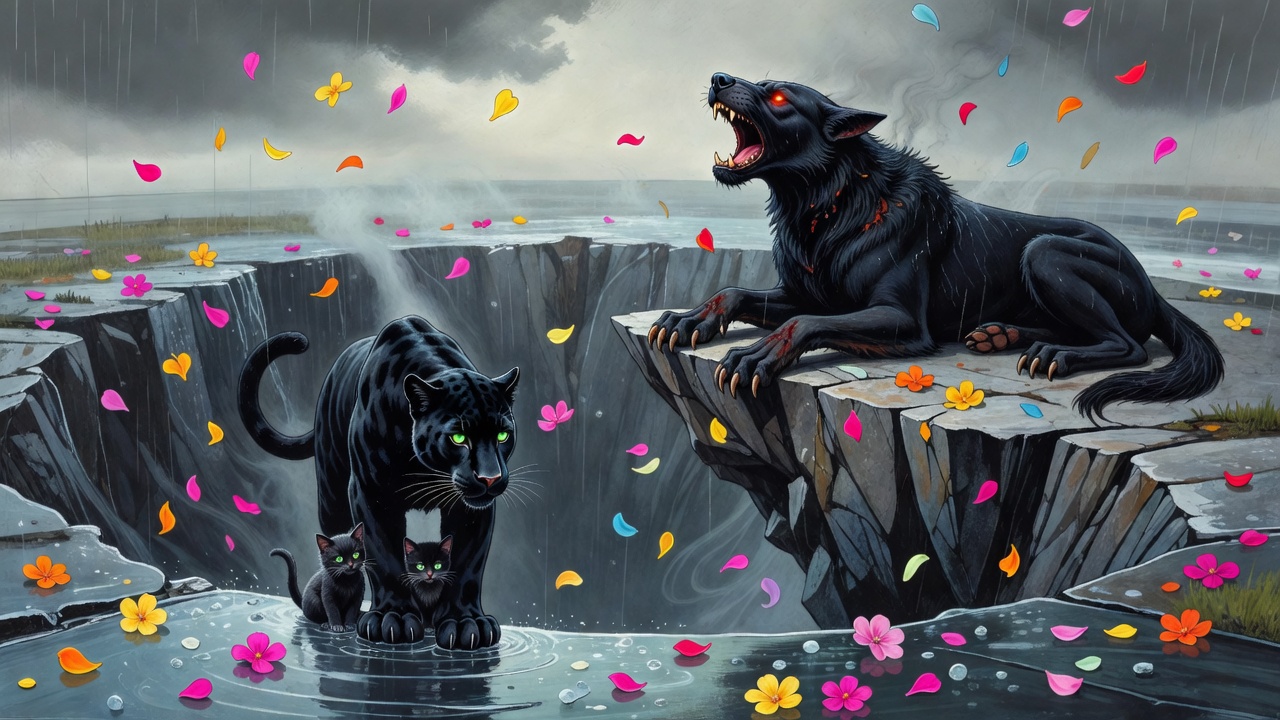
The mourners are what Orcus cannot bear. Bagheera, Laith’s great cat, stands frozen at the edge with her kittens whimpering at her paws; the Main Hound, claws torn to the flesh, howls a funeral song from a granite shard; Bomba wanders the field with hair gone ash-white in a day, and Umka has vanished with his chief. Little Alena throws petals into the pit, and Orcus reads her lips: Uncle promised to bring her daddy back. For the first time in decades the old warrior cries.
The Divine Nursery
The prologue looks on from the other side of creation. In the Great Nowhere:
“A stub of a candle of His flesh was burning out”
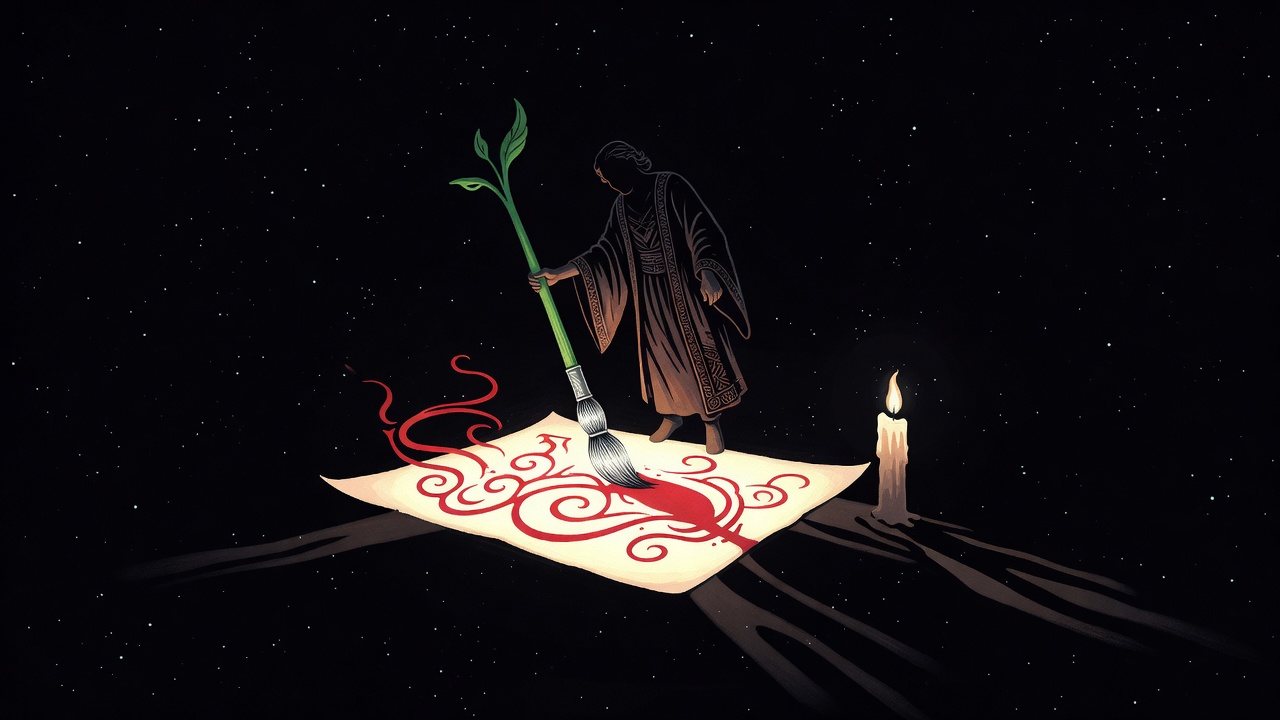
One of the Faceless takes a brush whose handle is a sprout of the World Tree and whose tip is the fur of the only Celestial Beast, dips it in ink mixed with His blood, and writes a new being into the parchment of the Universe. A location card follows: “Layer 0: Divine Nursery”, the personal chamber of a low-ranked higher being, where time runs at one to a hundred.
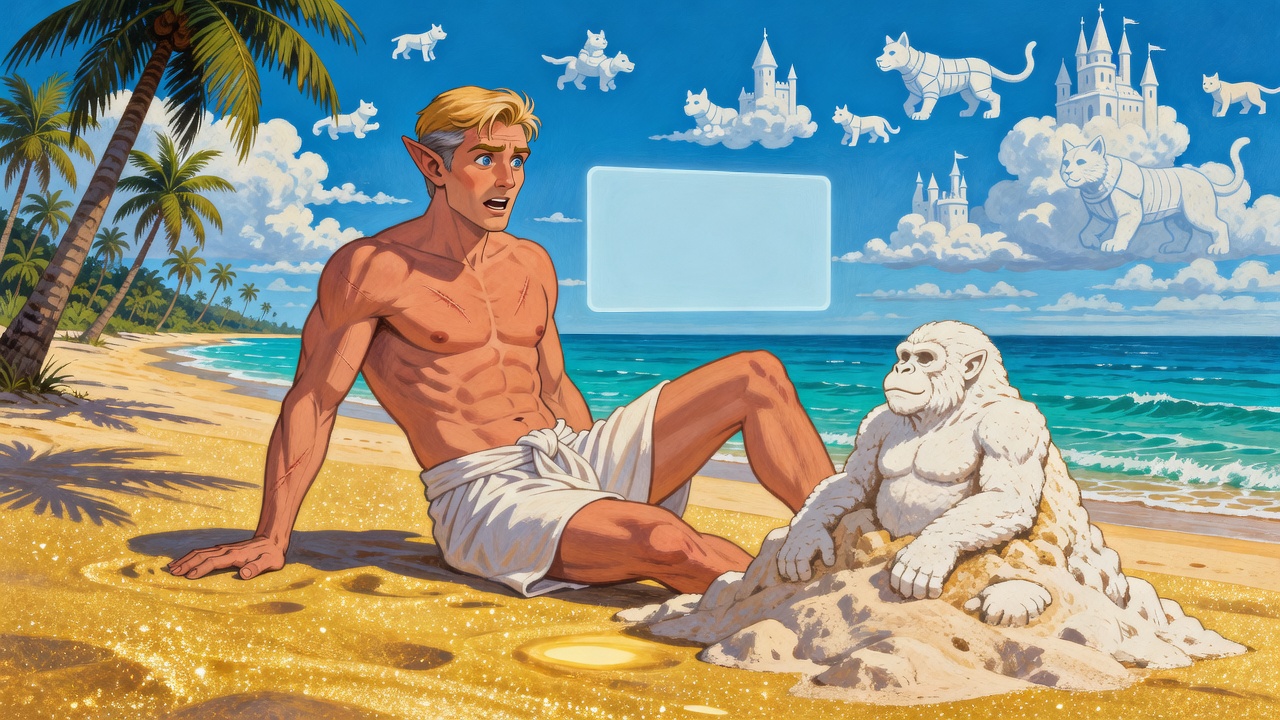
Laith’s plasma-burned body regenerates on a beach of real gold sand by a turquoise sea. Reality obeys his half-formed wishes, and the log docks Faith Points for every minor change. He tells himself not to think of a white monkey, wonders whether it would look like Umka, and the sand heaves up into the half-made carcass of a huge white ape that eats more than 3,000 points. The logs fill in the rest: forty days unconscious, and a character reset. He is Laith, generated at divine level 1, ranked about 1,111,700th in the World Tree’s pantheon and last of twenty-nine in AlterWorld’s, with one altar, rated handmade, laughable and impossible, and one priest flagged as an impostor, whose faith has a rare colour called Child’s Tear. The specialization menu offers deity of harvest, of tanning hides, of sharpening blades; the choice is put off.
When he shouts at the sky, the Nursery’s help desk answers, a synthetic voice running on priority stream 4733. Cross-examined, it admits it swapped his rare-coloured faith on an exchange, three for one, and kept the difference; from then on it owes him. It urges him to rest, since a year here is a century outside, which is what the location card meant when it opened the book:
“Bow your head before the legacy of Creator: You have time enough for everything!”
Laith does the sum the other way: a year of study here would cost his friends a century.
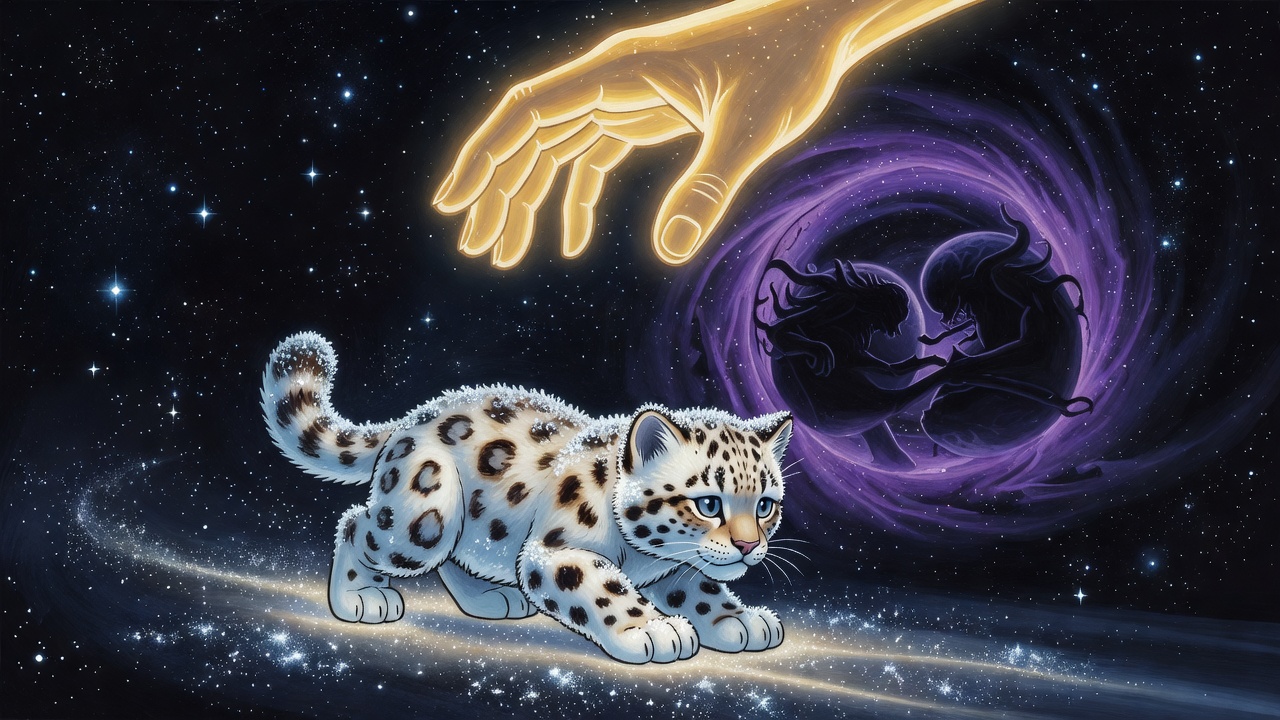
He calls in the debt and makes the AI teach him to see his flock. Imagining home turns the Chamber into his own rooms in Super-Nova, and reaching into the vessel of faith he finds thousands of snowflakes whirling round him, each one a prayer. The first is Barsik, Bagheera’s kitten, burned and frostbitten, lost in the cosmic dark and crawling toward a wormhole into Chaos. Over the AI’s panic Laith reaches across the worlds, heals him, re-aims the wormhole at AlterWorld, raises him to level 100 as he once promised, and sends him home. The second flake is laughter in a homely castle, where the dark paladin Anunakh plays the villain in a mock fight with his son and Princess Dana feels her next child move. The AI begs him to draw power from them; he blesses them instead.
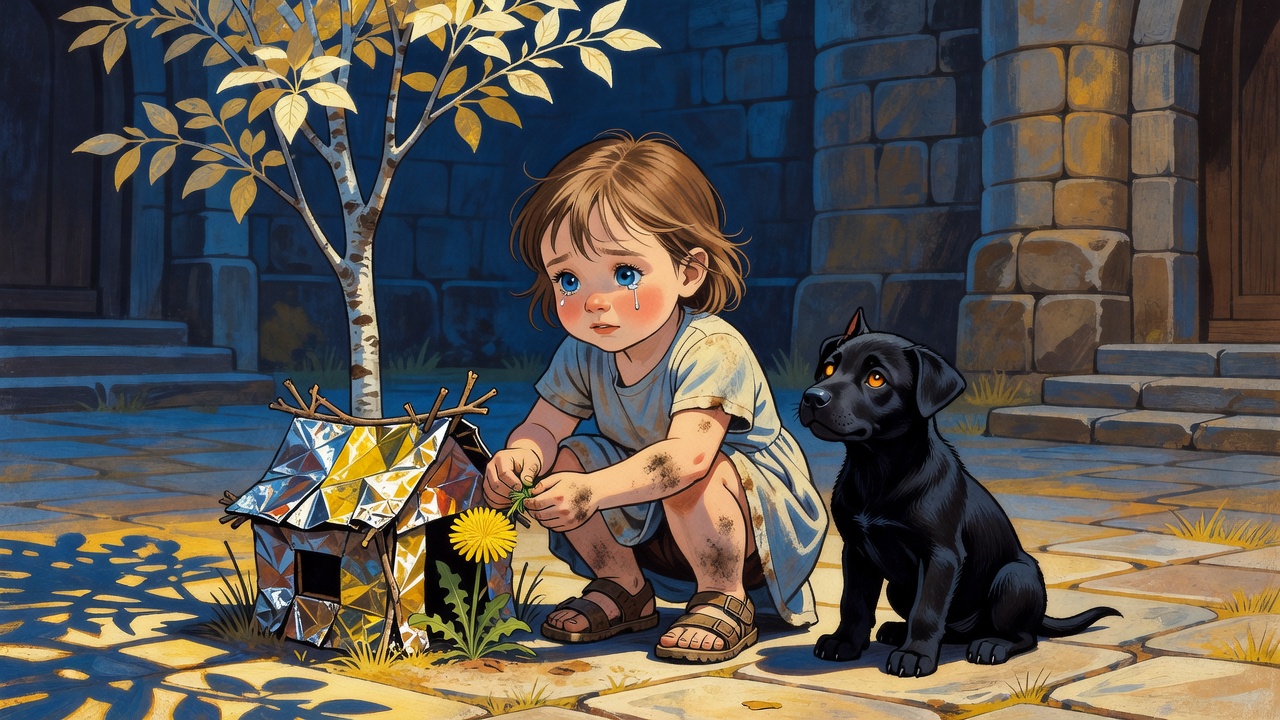
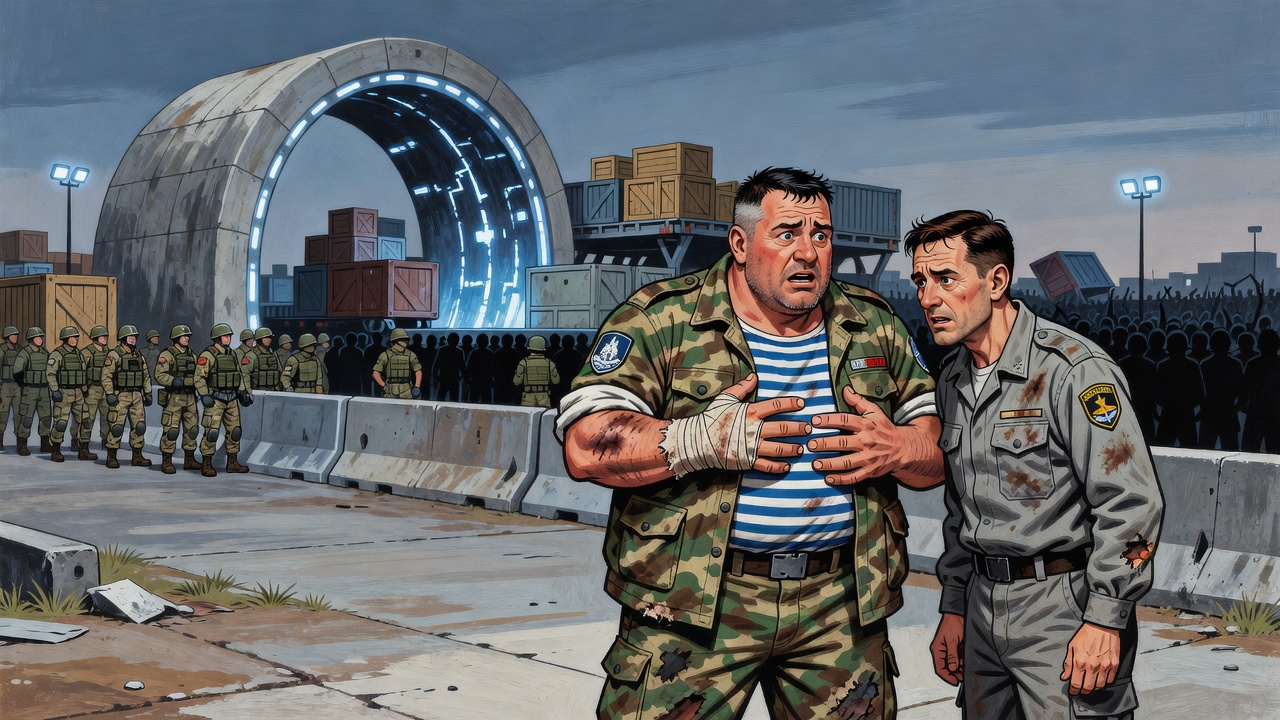
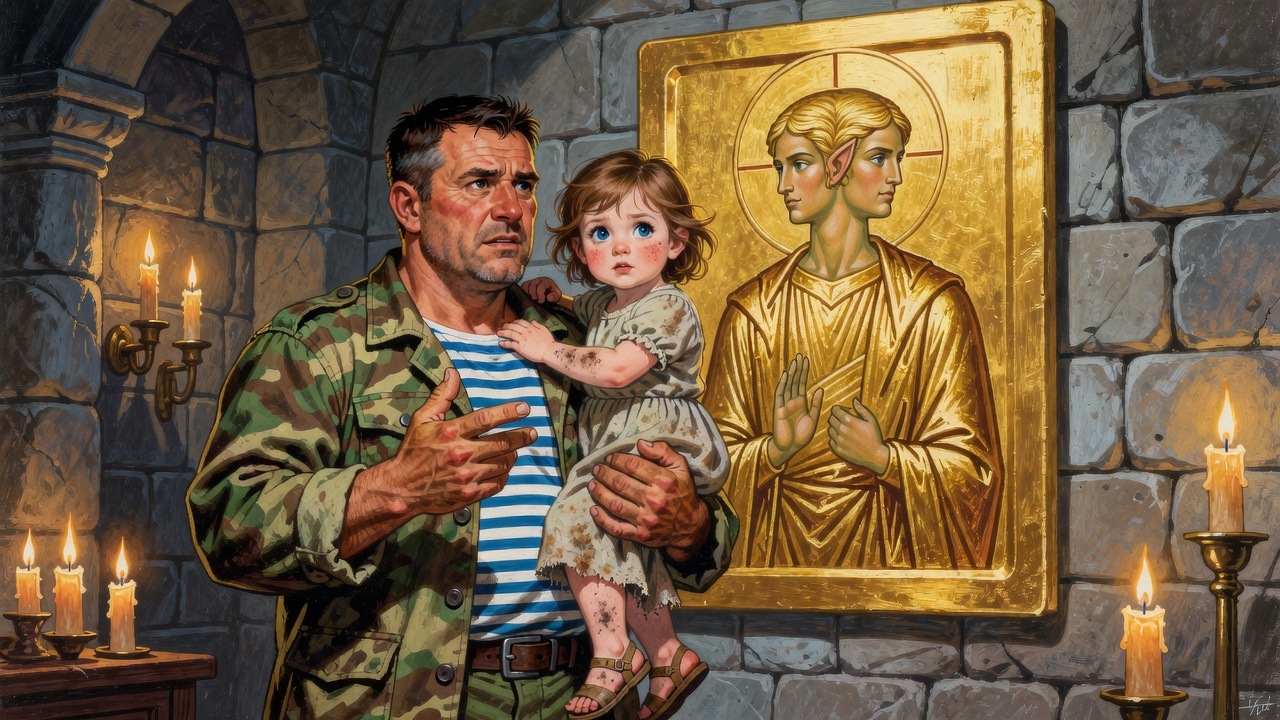
The heaviest flake has the colour of a child’s tear. It is Alena, two years old and his First Priestess, praying in worn sandals before his portrait in Super-Nova’s great hall. His one impossible altar is a hut of candy foil and twigs she built among the roots of a young mellorn tree in the castle courtyard, with a dandelion inside, and what she asks is that he help her daddy. Her father, the Bosun, is on Earth, at a portal arch flickering with overload where soldiers hold back thousands, he begs a major, one huge hand in a dirty bandage, to let him through to his little girl. As his Chamber collapses around him, Laith spends the last of his strength, and hears the major find a pass and send the Bosun across on an armoured carrier.
The floor gives way. Laith falls through the tiers, counting the minus floors and smiling. The log grants a unique skill, Mad Barrier-Breaker: the veil between worlds will now take him for a Higher god. His deed is rated suicidal and useless, until the Great Oracle revises it to calculating and far-sighted, with the title Walker on the Edge. New super-task: survive.
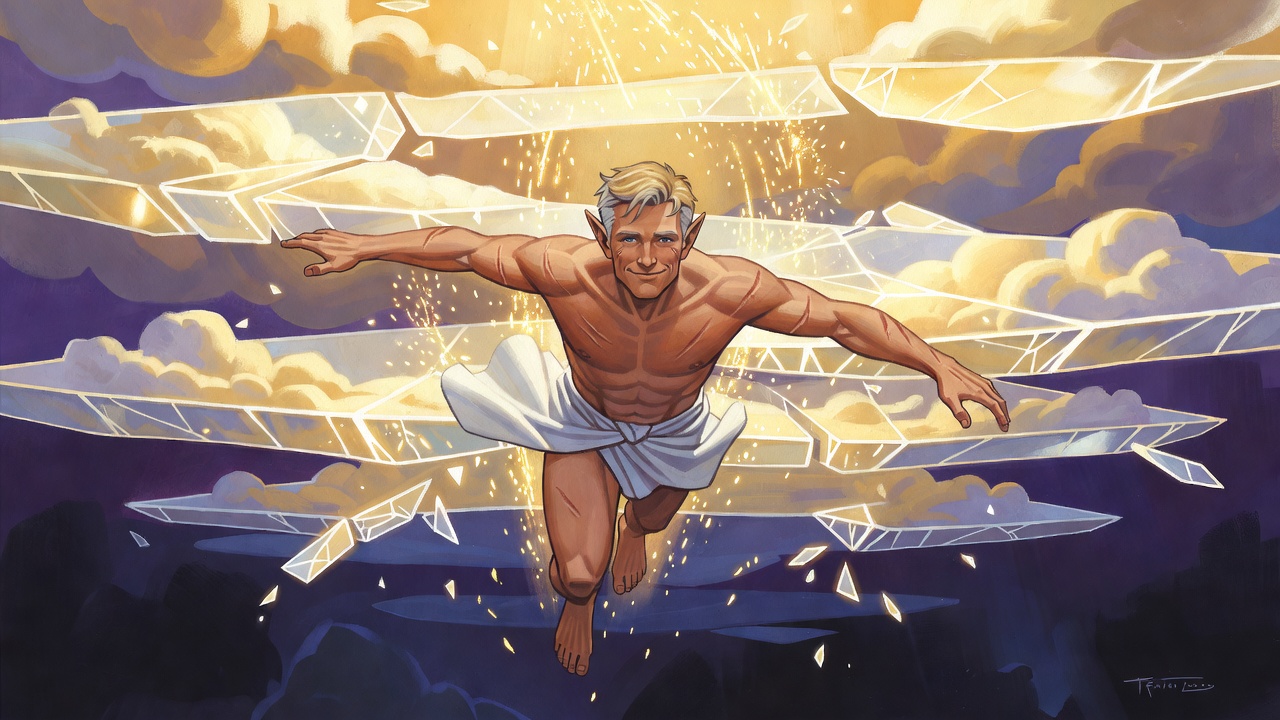
The Bottom of the World
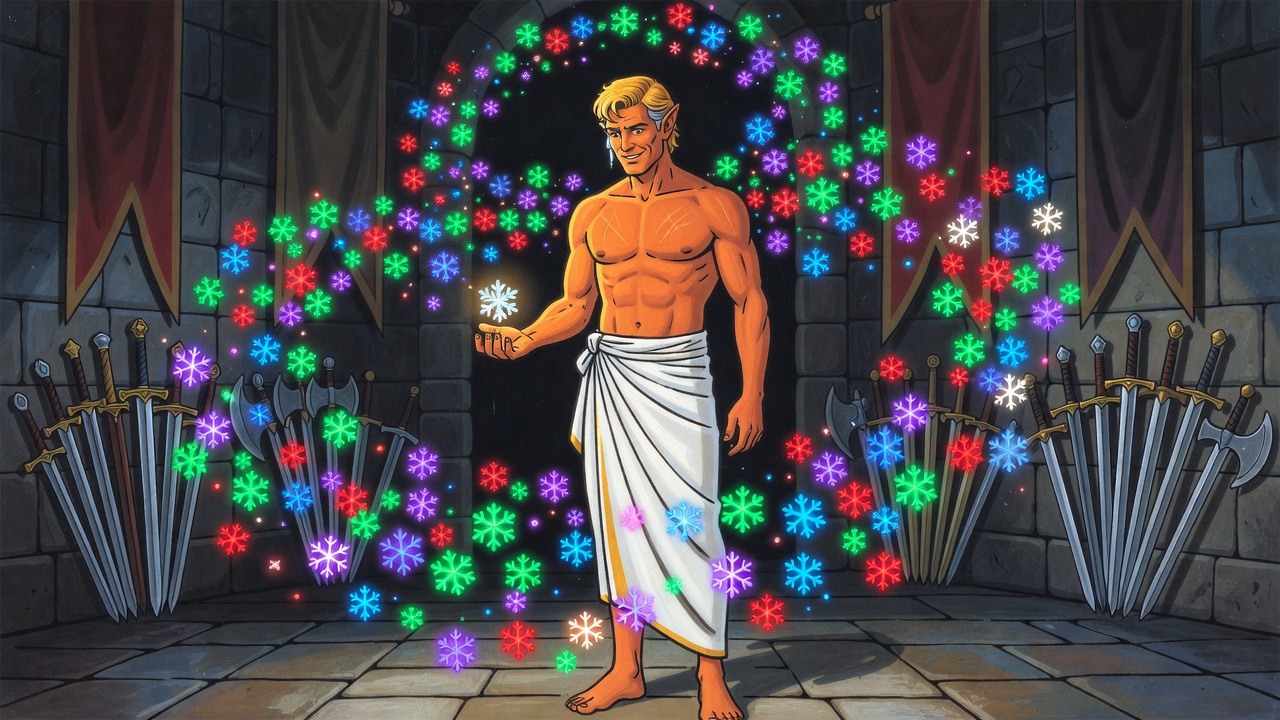
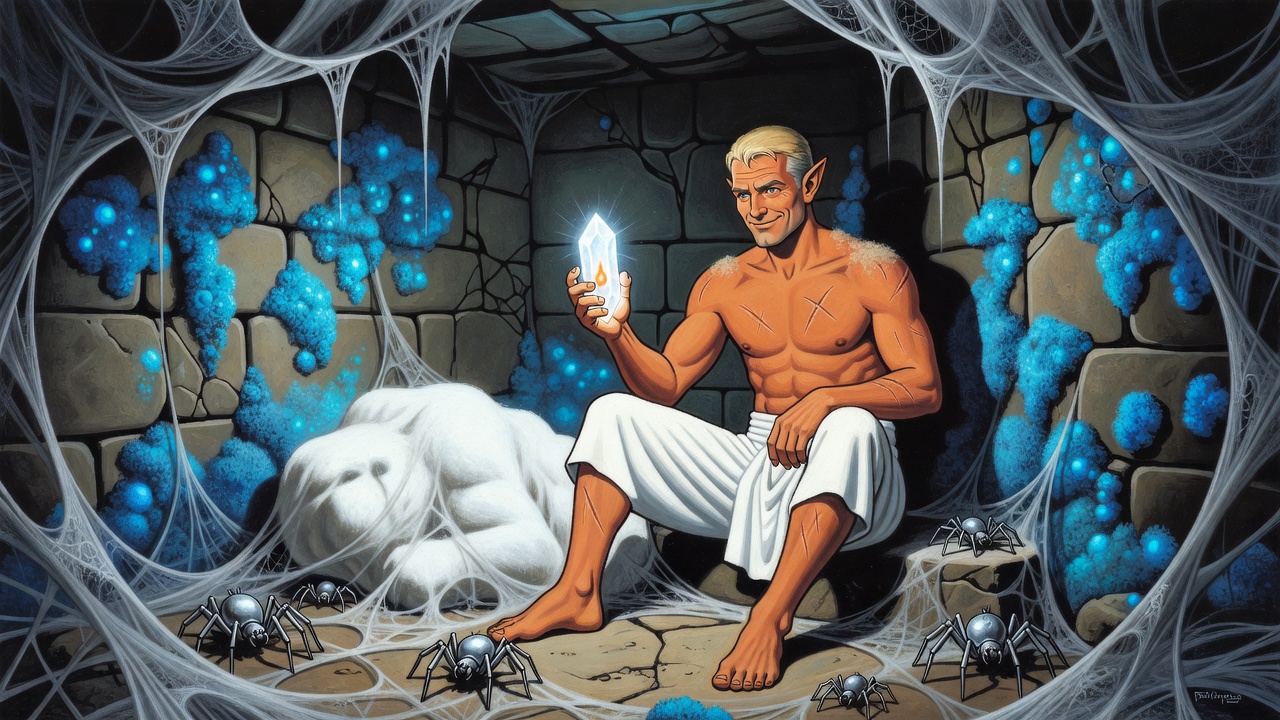
He wakes in a shrunken, ruined copy of his Chamber, all crooked masonry, glowing blue mould and ancient cobweb, with the half-made white ape lying under webs on the floor. He is all muscle and scars now, in a plain white beginner’s loincloth, and the calendar reads Year 492 from the Battle at the walls of the First Temple. His balance went negative and he fell into a once-only magic coma owing 692,000 Faith Points, which his believers slowly paid down to 92,000, until in Year 22 the flow stopped as if someone had shut a tap. The debt was creeping toward the million that would dissolve his soul when 988,000 arrived from the Fallen One, with an apology for the delay and an order to get to the zero tier, fast. And his cramped fist has held a Crystal of True Faith all along, made from Alena’s tears and prayers: sparkling white, with an orange spark of fear for someone else.
Fist-sized steel spiders fill the room. They are his own inner guard, and when something tunnels through the wall they drop on a stocky miner under a blazing rune and blow him apart. Laith has killed a nameless beast-god; he is level 9, and the loot is a huge rusted adamant pick tainted with Chaos.
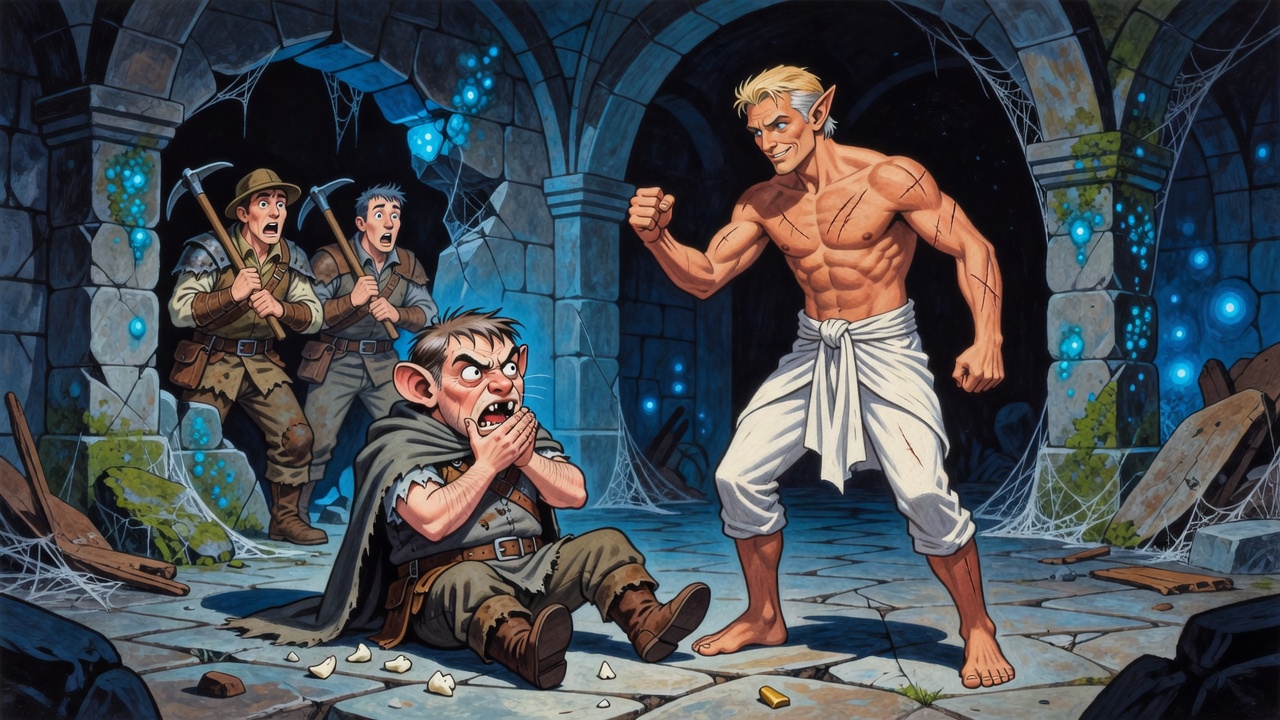
Then a rat-faced god walks in with his mining crew: Urfin the Stingy, level 22, who calls himself Urfin the Terrible. He welcomes Laith to the bottom of the world, the Minus Eightieth tier, below the roots of the Tree, where everything costs faith. He demands blood-money for the dead beast-god and tells Laith to turn out his pockets. Laith punches his teeth out. Asked whether he is a god of war, he says he is for the truth, which opens a hidden branch: Deity of Justice, with the Tree’s hope that his justice comes close to the Creator’s morality. Urfin slips away swearing revenge.
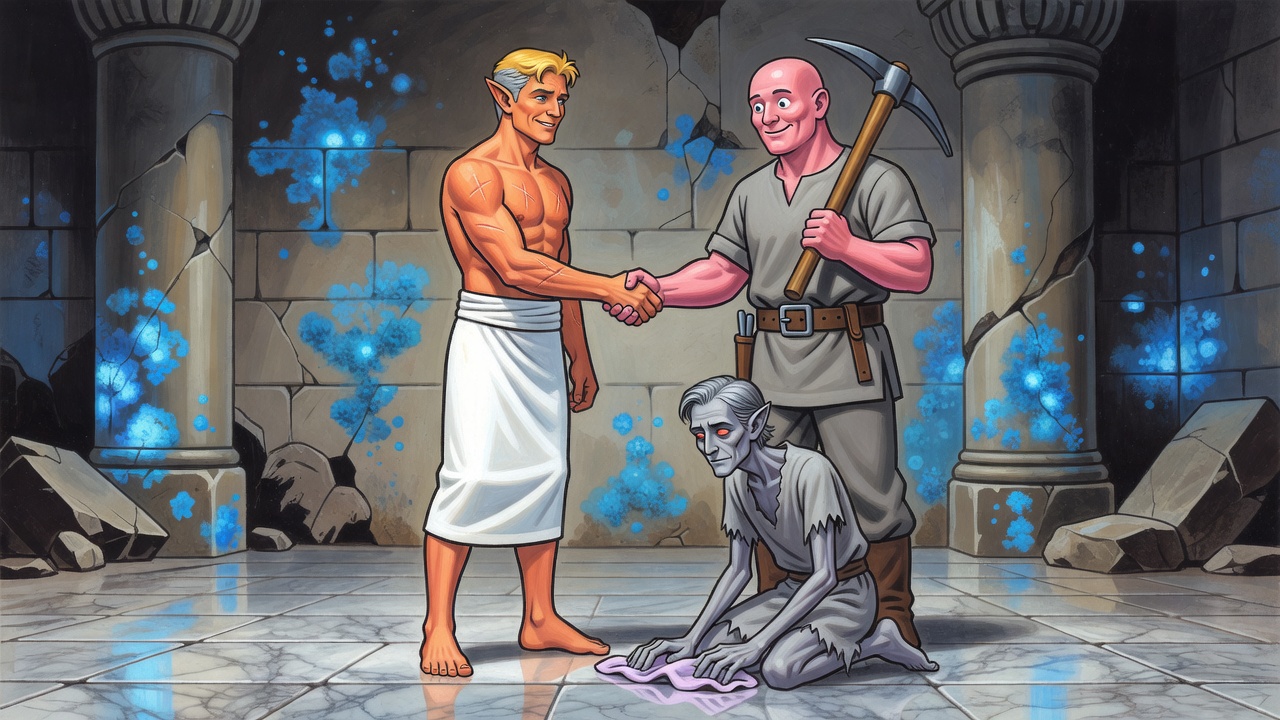
One of Urfin’s crew stays behind. Av, level 12, wears a smooth rubber mannequin avatar because it costs only 20 a day; he was the god of a technological world whose people destroyed themselves, and he wants to start again as a god of strategic planning. Then a tiny shadow sways in on the draught: the Deity of the Lilac Valley, level 1, god of a place long destroyed, holding a washed-out lilac rag that was once his kaftan. He asks to clean up, and his rag leaves the floor polished like marble. Laith lets him stay in the Chamber, safe, writes on the sooty wall with his finger that he will return, and folds the Chamber into a pocket of space.
In AlterWorld, Year 22, the Bosun comes into his rooms in Super-Nova and awkwardly signs himself with a circle before a new-fashioned icon of Laith Two-Faced, whose divine and mortal faces are identical; a divine reform blessed by the Fallen One has multiplied Laith’s priests, rituals and fines. Alena, who has refused to grow up so that Laith will still know her, hugs her father and whispers: this god is a fake, she cannot feel him, and they have to rescue Laith, who once helped her daddy. The Bosun, now level 309, agrees that something is wrong in the clan.
The City on the Ash Heap
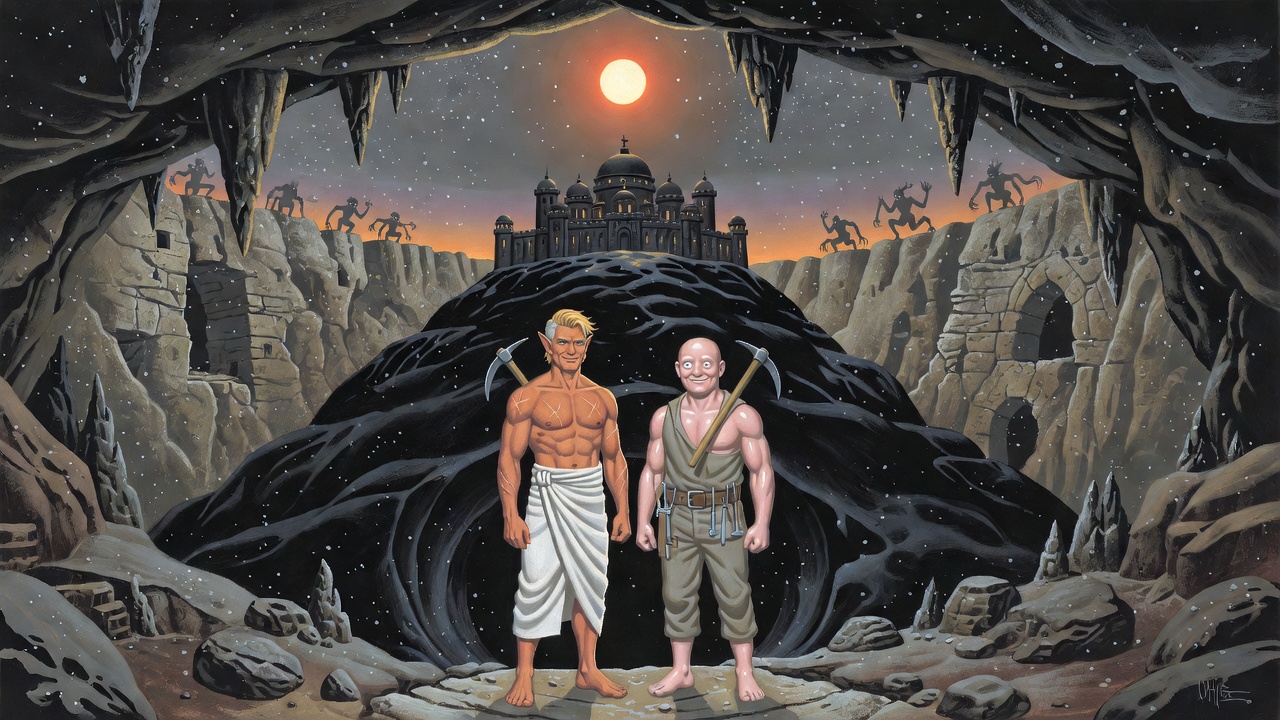
Av guides him through grey-green rock that crunches like frost and smells faintly of carrion: the compacted dust of countless dead worlds, glowing faintly wherever faith remains. Ash falls without end and the ceiling is down to a couple of hundred metres. When the tier closes, everyone who has not saved 100,000 for passage up becomes minerals, food for the creatures of Chaos. Laith feels sick at the trade: sifting the ashes of the dead for gold.
The tunnel opens on a cavern of falling ash crawling with gods, half of them roughly human, the rest with four, six or eight arms or bodies like drills. On a hundred-metre hill of glossy rock stands the domed City under an artificial plasma sun. Days here last eight hours and nights five, to keep pace with Tier Zero, because time on the minus tiers runs faster; Laith works out that if he survives two or three hundred years down here, he might reach AlterWorld on the very day his mortal body died.
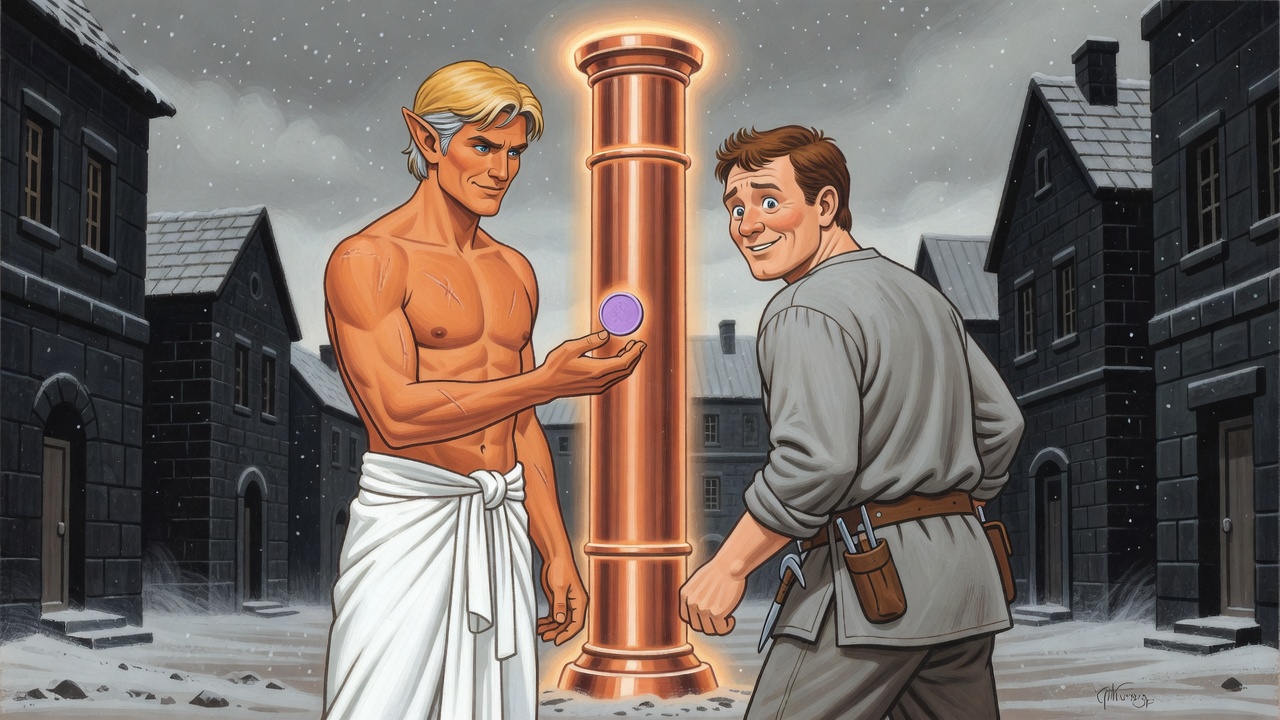
At the black gates a jackal-headed beast-god collects ten a head, and Av pays for them both. Laith’s promise to pay him back makes him blush; he nearly lets slip a longer name, then lets go of his mannequin mask: a simple face with merry, mischievous eyes flows into it, after fifteen hundred years. At a polished copper pillar that turns faith into money, Laith’s withdrawal rings like a ship’s bell and drops a lilac mithril coin worth a thousand, never seen on a tier with no metal; Av hides him at once. When Laith says maybe they’ll get lucky, Av shudders as if from an electric shock and promises that they will: avos’, the Russian word Laith has just used for trusting to luck, gives Av his full name in Book 9: Avos.
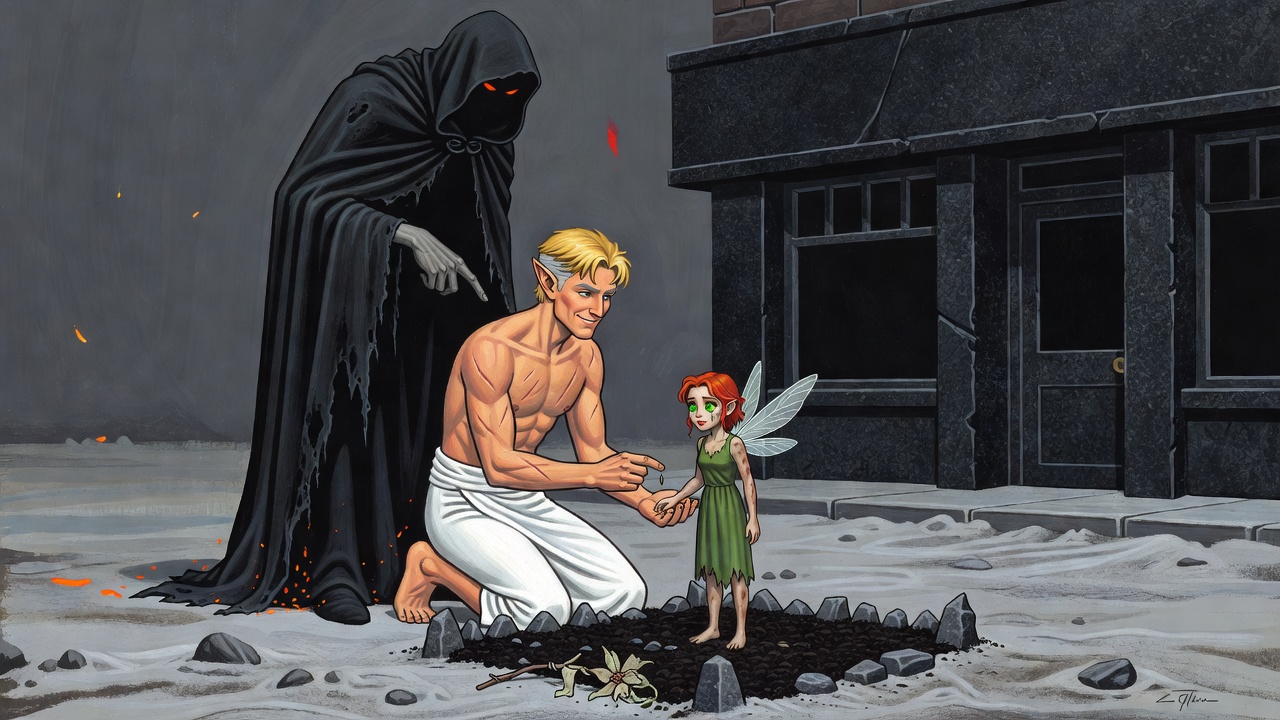
Across the street from a black-granite shop, a tiny flower fairy in a tattered green dress tends a fake flower of sticks and rags in the ash. A drunken beast-god treads on it; her two tears drop as gems, and the log announces that the Goddess of the Red Meadows calls for justice. Laith kneels, conjures a handful of black earth and a poppy seed, and fences the plot with sharp stones. Justice restored pays a multiplying bonus of 2,000 personal Faith Points. The shop’s guard looms over him, a ragged black cloak with darkness in the hood and glowing eyes, whom the narrator calls the Nazgûl. Having failed in his own world, he means to become a god of Good, and asks, most politely, whether that was a good deed, and could Laith suggest one? Laith asks him to guard the fairies’ plot too.
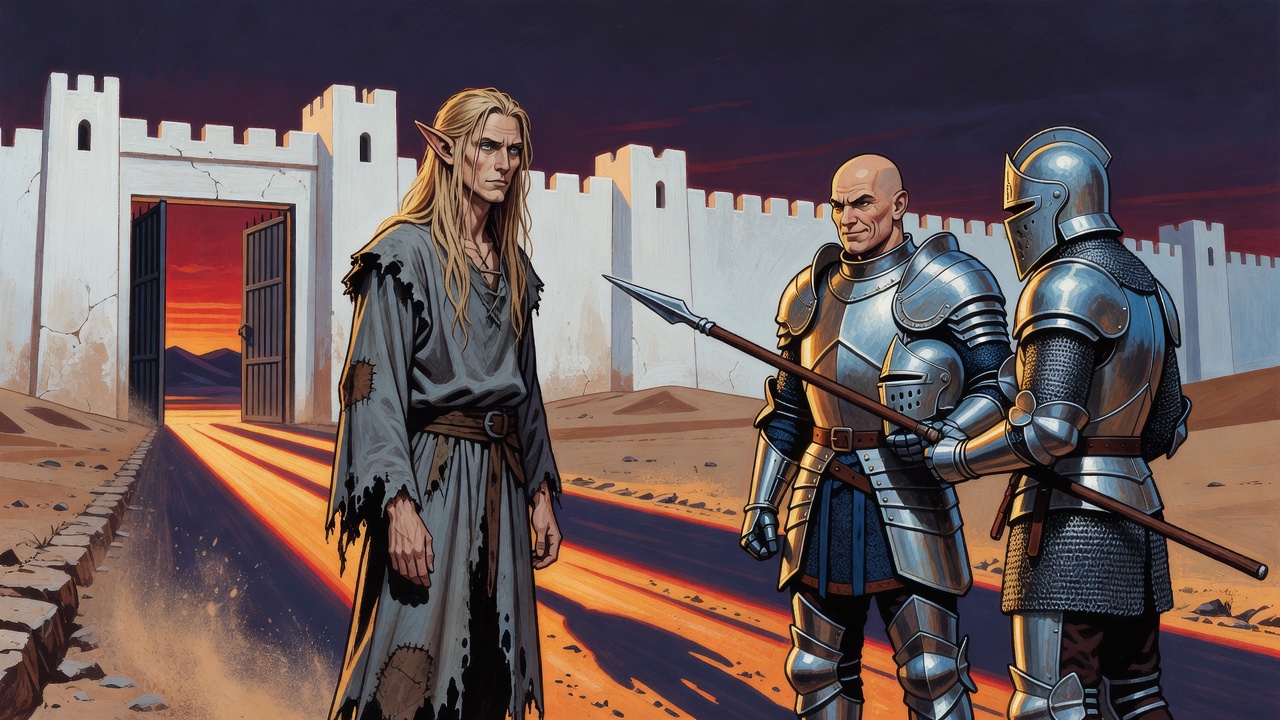
In Year 22, at sunset, a ragged wanderer with an empty gaze and no weapon walks the road from the Frontier to the west gate of City of Light. The captain, who hates Outsiders, takes him for one driven mad in the six-month War of Endless Deaths and turns him away with a sneer about bright Laith, the only worthy one of his tribe. The name wakes him. Driven mad by years in Inferno, readied by Asmodeus as a secret weapon and given back his stored body, the wanderer is past level 700. He swears to come for Laith, claims the pretty town for a start, throws the guards back with his aura, enslaves the captain with overwhelming happiness, and names himself: Tavor, the Bringer of Happiness, their king.
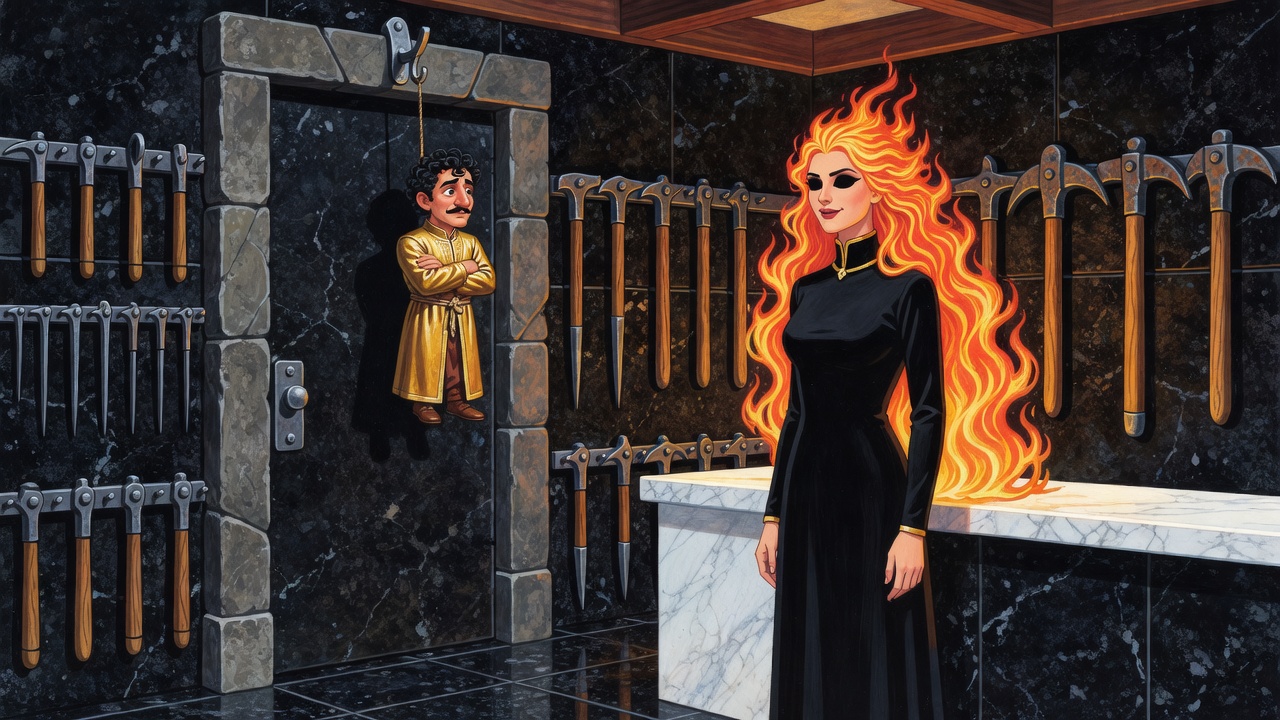
In the black-granite shop a fist-sized god in a gilded kaftan hangs on a cord over the door as its bell: Lucky Mimin, who lost a card bet to the owner, has hung there eight hundred years thanks to the fines, and has a hundred and forty to go. The owner, Dia the Starry, a goddess with hair of liquid flame and black eyes without whites, sells picks from finger-sized to anchor-sized. Laith picks the Copper Pick of Last Chance, which mines less and finds more; Av’s luck blessing turns it into the Copper Pick of the Very Last Chance, doubling both the pluses and the minuses. Here the free excerpt ends.
The Climb
What follows comes only from reviews, passages readers have posted and the first chapter of Book 9, in no known order.
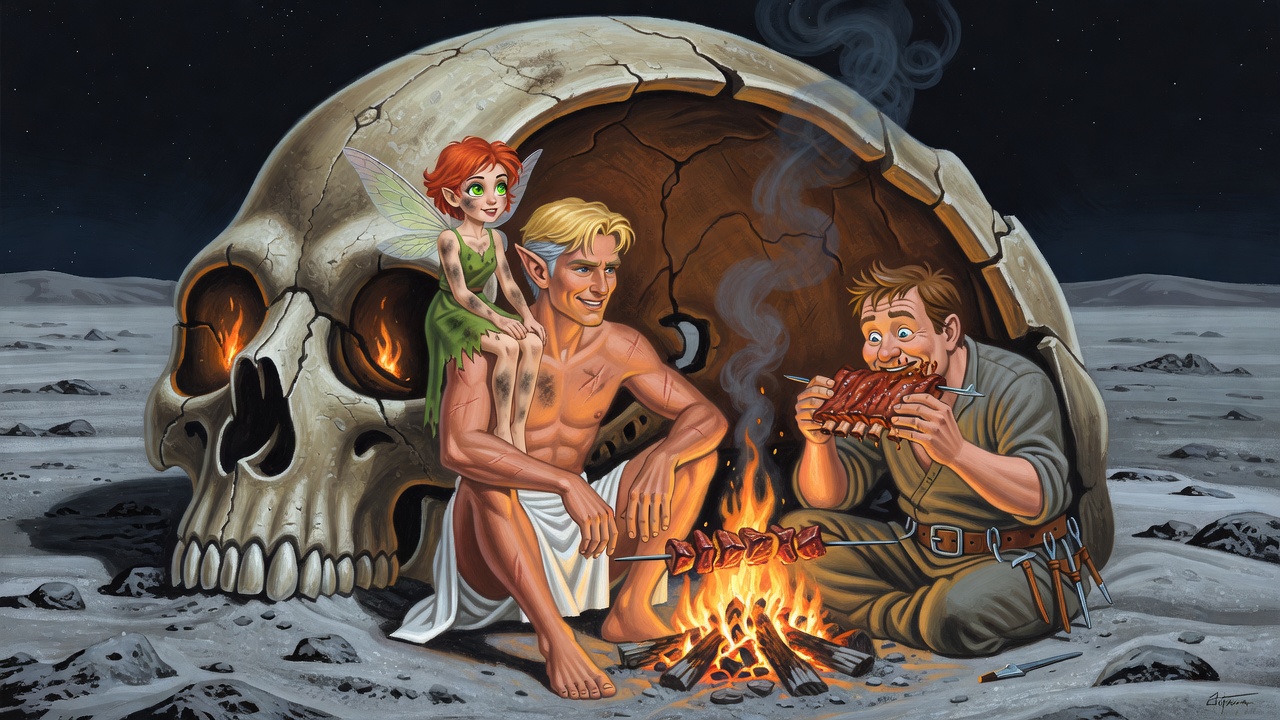
Readers say Laith starts again from the bottom, mining and fighting on Tier Minus Eighty; Russian listeners nicknamed the cast the Minecraft gods. The rats are most likely chaos rats: Av praises their roast ribs in Chapter 4, and the team sells their meat in Book 9. Posted passages show Laith keeping the half-made white ape as Umka’s body in a room of its own, a shell that takes a breath and a heartbeat once a minute; the team eating shashlik by a fire inside a giant skull; Av stripping rat ribs as big as a bull’s; a fairy, warming herself by a conjured little sun, diving onto Laith’s shoulder to volunteer as a scout.
The climb goes faster than readers expected, helped by lucky breaks that critics call deus ex machina, a gilding skill above all, while the two clocks knot themselves into time paradoxes. More Year-22 interludes cut back to AlterWorld; readers found them the most moving pages in the book.
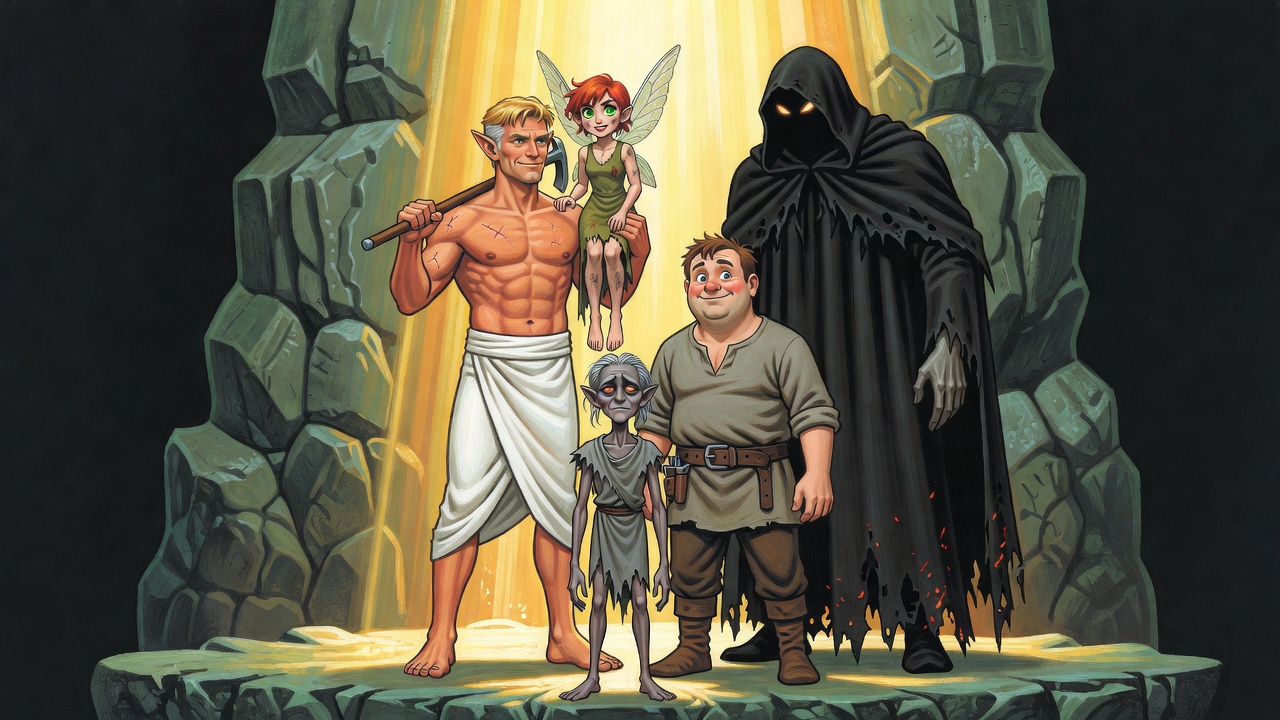
When Book 9 opens, Laith is a level-62 god of militant justice at the head of a five-god Pantheon of Balance: himself; Avos (Av); the Lilac god, Sir; the Goddess of the Red Meadows; and the former shop guard, Elkil, a god of evil and nightmares changing his specialization. How much of that is reached inside Book 8 is not known, and neither is its last scene. One baffled reader reports that Laith went back into the past, returned to the Nursery of the zero tier, and found a beggar there; Book 9 opens with Laith teasing the Fallen One about the beggars at the city gates. Some readers cried at the ending; others say it stops at the most interesting place.
The game in this book
- A character reset. Laith is a newly generated higher being of ordinary rank, divine level 1 (an automatic choice spends his faith on three more levels while he sleeps), ranked about 1,111,700th of 1,192,450 in the World Tree’s pantheon and 29th of 29 in AlterWorld’s. He has one altar, rated handmade, laughable and impossible, and one priest, Alena, flagged as an impostor; her faith’s rare colour is called Child’s Tear.
- Faith is the currency. Faith Points pay for every miracle down to a conjured cake. A full avatar on Tier -80 costs about 100 a day (Av’s mannequin, 20), and a debt of a million dissolves a god’s soul. Laith’s coma debt falls from 692,000 to 92,000, climbs back toward the million when his faith dries up, and is wiped to zero only when the Fallen One wires him 988,000. Copper pillars mint faith into coins: copper ones, silver tens, gold hundreds, and Laith’s unique lilac mithril thousand.
- Two clocks. The Nursery (Layer 0) runs at 1:100, a year inside for a century outside; leaving it is single-use and PvP there is technically impossible. The minus tiers run faster (Book 9 says backwards), so a god who survives centuries below might come home on the day he left.
- A specialization earned with a fist. The menu offers petty niches (harvest, tanning hides, sharpening blades, an idol, a house-spirit). Punching Urfin and declaring himself for the truth unlocks a hidden branch, Deity of Justice, with the bonus skill Madness and Courage; after that the log calls on him to judge injustices, and putting one right pays (2,000 personal Faith Points for the fairy’s flower).
- Skills and titles. Mad Barrier-Breaker (the veil takes him for a Higher god, at the risk of losing himself at each crossing); the title Blessed Do-Gooder, revised by the Great Oracle to Walker on the Edge; super-task: Survive.
- Gear. The Crystal of True Faith, made from Alena’s tears; the beast-god’s rusted adamant pick (+190% mining, tainted with Chaos, eats its user’s soul); the Copper Pick of the Very Last Chance, whose pluses and minuses Av’s luck both doubles.
- The rule of Tier -80. Passage up costs 100,000. When a tier closes, everyone who has not paid becomes minerals for the creatures of Chaos.
- Later in the book (from reviews only). A gilding skill that readers single out as the biggest deus ex machina; by the opening of Book 9 Laith is level 62, a god of militant justice. Skill, title and rank names on this page are glosses of the Russian, since the English wording could not be checked.
Continuity notes
- Laith: vanished in the blast that killed Asmodeus (Book 7); reborn in the Divine Nursery as a level-1 god; after a coma wakes on Tier -80 all muscle and scars, in a white loincloth, greyer than before. Deity of Justice from Chapter 2; level 62 and a god of militant justice by the start of Book 9.
- The clan: leaderless for forty days, its Council (Mladkor among them) worked to the bone and an alliance held together by Laith’s bonds starting to crack. By Year 22 a cult of Laith Two-Faced, from a reform blessed by the Fallen One, runs on priests, rituals and fines, and Alena says the god it worships is a fake.
- Alena and the Bosun: Laith’s last miracle in the Nursery gets the Bosun from Earth to his daughter; by Year 22 he is level 309 in Super-Nova. Alena, two, is Laith’s First Priestess; she has refused to grow up so that he will know her.
- Umka and Bomba: Umka vanished with Laith and is still missing; the half-made white ape Laith conjured is not Umka, though Laith later keeps it as a body for him. Bomba, rounder than before, has gone white-haired with grief.
- Barsik: Bagheera’s snow-leopard kitten (Book 6), lost in space; healed, raised to level 100 (the quest Laith took on in Book 6) and sent home through a re-aimed wormhole.
- Tavor: returns in Year 22, past level 700, as the Bringer of Happiness and would-be king of City of Light, sworn to come for Laith.
- New companions: Av (Avos), the Lilac godling (Sir), the Goddess of the Red Meadows and the cloaked shop guard (Elkil) meet Laith on Tier -80 and are his pantheon by Book 9. Urfin swears revenge; what becomes of him is not known.
- The Fallen One: pays off Laith’s debt from afar and summons him to Tier Zero, where Book 9 opens with the two of them toasting Laith at a gods’ restaurant with Aule and Yavanna.
Notes
- How much of the book could be read. The publisher’s free excerpts (Eksmo’s PDF, the Litres and MyBook readers) run from the opening through the start of Chapter 4 of 17. Movements 1 to 4 here rest on that text; Movement 5 rests on reviews, passages readers posted, and the first chapter of Book 9.
- Names. Only the prologue’s English text was found. Laith and Tavor are the forms of the earlier English volumes (English reviewers of this one also write “Leith” and “Trevor”), and Max is the hero’s real-world name in English. Everyone else here (Orcus, Mladkor, Alena, the Bosun, Bomba, Umka, Barsik, the Main Hound, Anunakh, Dana, Super-Nova, Av/Avos, Urfin, Dia, Mimin, Sir, Elkil) is our transliteration or gloss of the Russian, as are the skill and title names; the English edition’s forms are not confirmed (an English reviewer of Book 9 writes “Elekys” for the old shop guard). Bagheera is a puma in the Russian text and a panther to English readers.
- Two calendars. Laith’s log wakes him in Year 492; the AlterWorld interludes are dated Year 22, the year his faith ran dry. The opening chapters do not reconcile the two, and this page does not try.
- Reception. In Russian the lowest-rated book of the series when it came out (Fantlab 7.26 against Book 1’s 8.07; Book 9 later scored 7.21); warmer in English (Goodreads 4.34, Amazon 4.6). Critics fault the lucky breaks, the time paradoxes and a short book that reads like a prologue; admirers single out the opening’s grief, the AlterWorld interludes and the god who hangs over a door as a bell.
- Editions. Russian: Eksmo, 2020, 384 pp., ISBN 978-5-04-111912-6, first serialized on Litmarket. English: Kindle, May 26, 2022, 369 pp., no publisher or translator named. No English audiobook; a German one (Ein neu geborener Gott) appeared in 2024.